Zhangjiajie 2-Day Itinerary: The Classic Wulingyuan Route for Easy Sightseeing
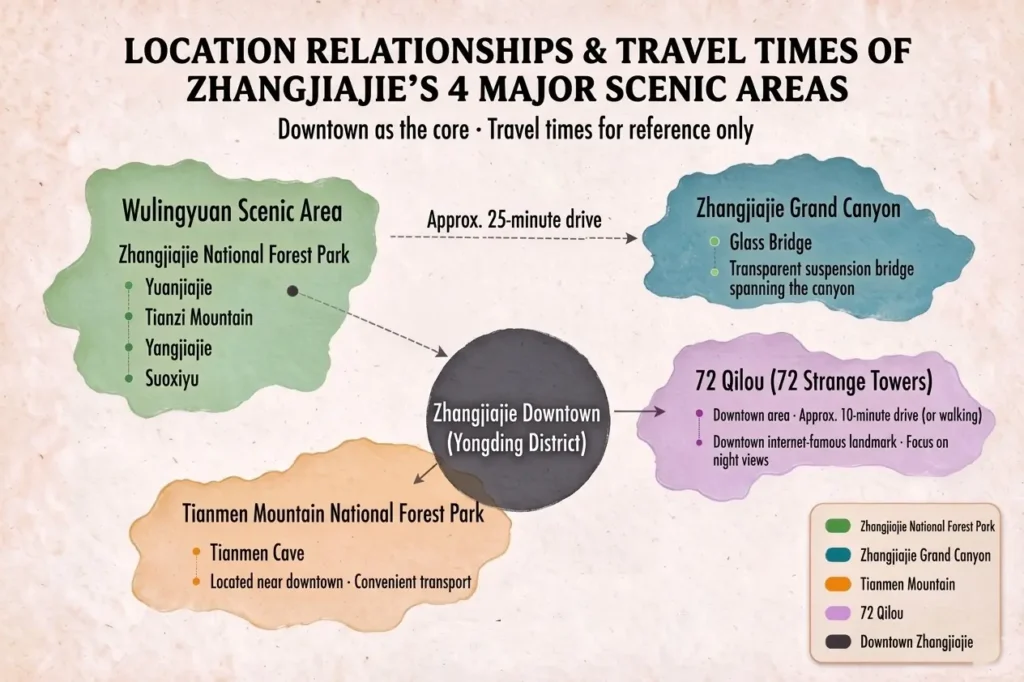
Visiting Zhangjiajie for the first time and wondering where to start? Just keep this simple formula in mind: 3 Major Scenic Areas (Wulingyuan, Tianmen Mountain, Zhangjiajie Grand Canyon) + 1 Downtown Area.
With only 2 days, trying to cover everything is a mistake—your best strategy is to dedicate all your time exclusively to Wulingyuan. Crafting a smart zhangjiajie 2-day itinerary requires a clear-headed choice: choose deep immersion in the core national park over trying to rush through everything.
This guide balances active exploration with comfortable pacing so that travelers with average fitness levels can easily complete it by leveraging mountain cableways and elevators. It spares you from physical burnout while ensuring you don’t miss a single view worth flying halfway across the world for. If you have high stamina and a deep love for active trekking, we have prepared an advanced Zhangjiajie 2-day hiking itinerary just for you.
1. Understanding Zhangjiajie National Forest Park & Wulingyuan
Many people think “Zhangjiajie” is a scenic spot. In reality, it is a city. The famous “Avatar floating mountains” that travelers want to see are located in the core of the Wulingyuan Scenic Area, specifically the Zhangjiajie National Forest Park. Remember this name, because your entire itinerary takes place here.
How big is Wulingyuan? It covers a total area of about 264 square kilometers, featuring five ticket stations and hundreds of viewpoints. Tickets are valid for 4 days—why? Because it is unimaginably massive, and one day is simply not enough.
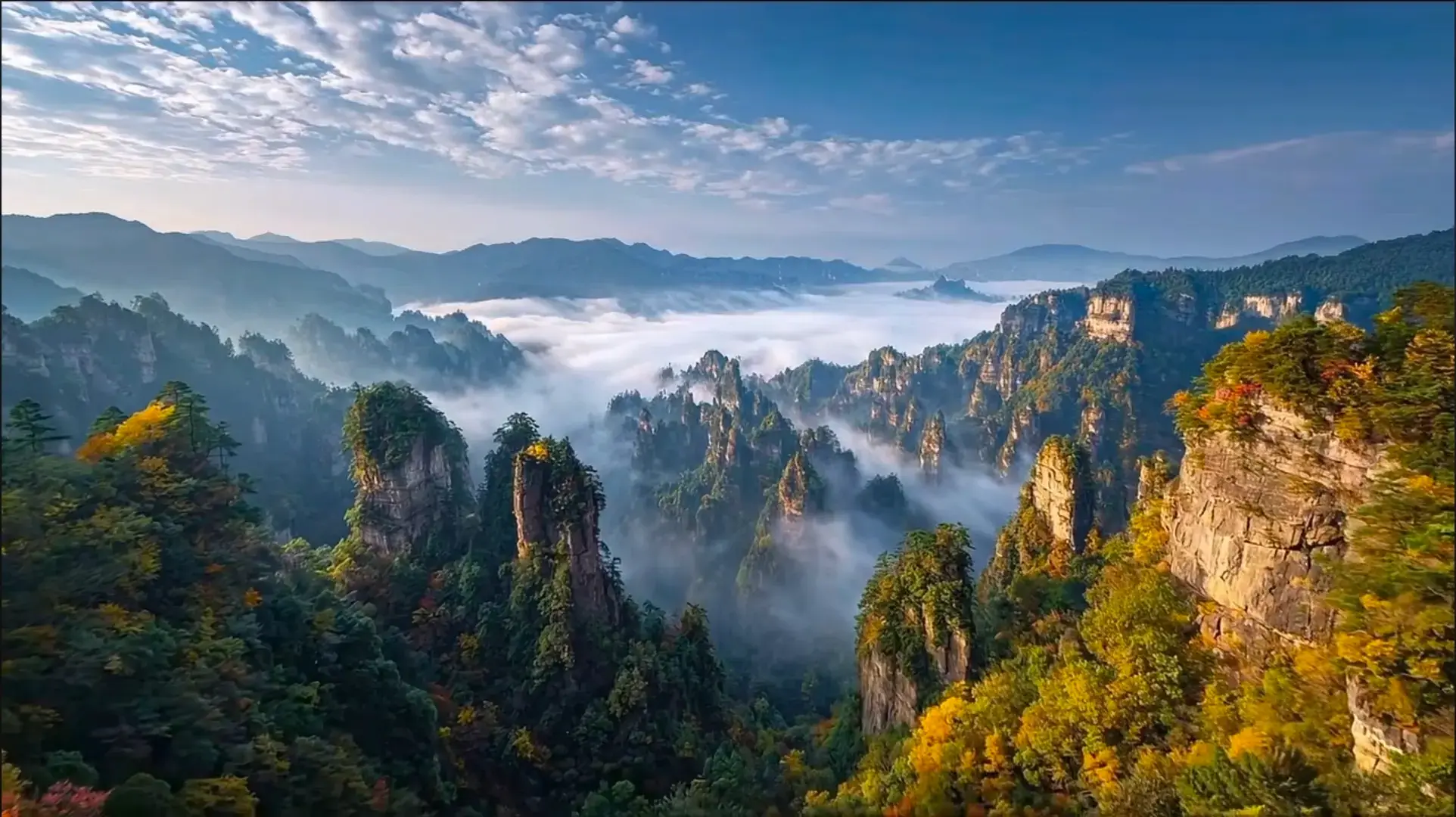
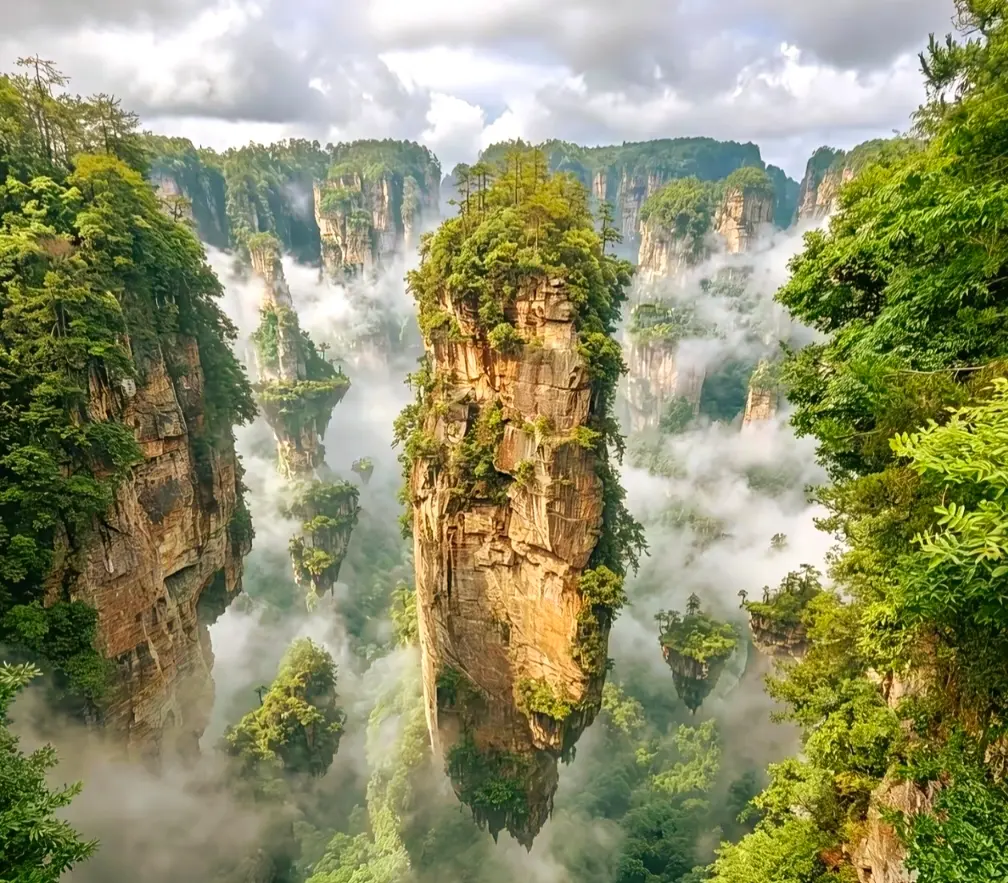
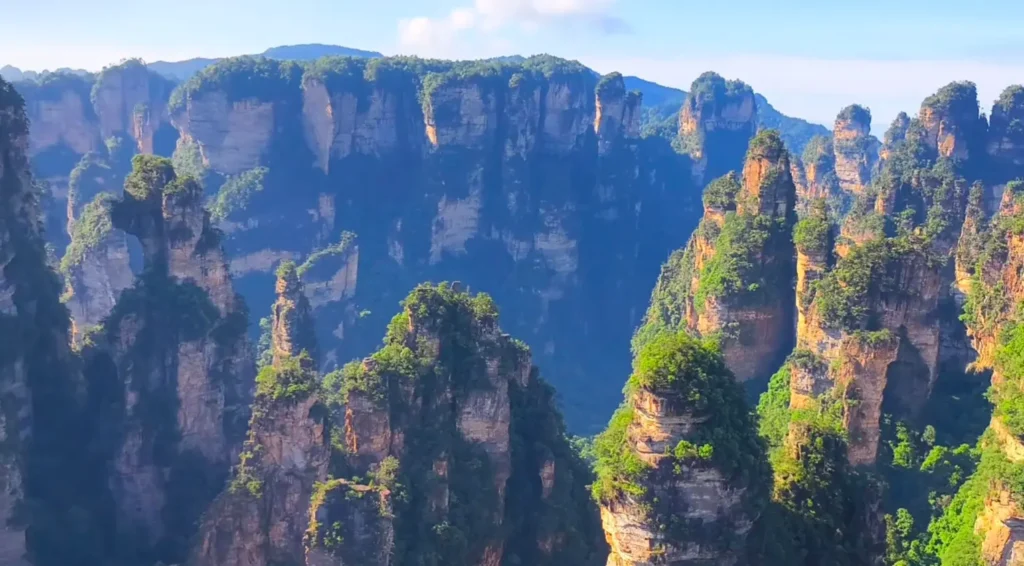
Therefore, for those planning a 2-day Zhangjiajie itinerary, my advice is straightforward: focus exclusively on Wulingyuan’s most iconic highlights, and resolutely skip Zhangjiajie’s other scenic areas. The core Zhangjiajie National Forest Park features a globally unique quartz sandstone peak-forest landform, a UNESCO World Natural Heritage site, and the inspiration for the floating Hallelujah Mountains in James Cameron’s Avatar. This place alone is worth flying across oceans to see.
When Is the Best Time to Visit Zhangjiajie?
Zhangjiajie’s scenery heavily depends on the weather. The exact same peak looks like a slender stone pillar in clear weather, an ink wash painting after rain, and vanishes entirely in heavy fog—so your experience is half about timing, half about luck.
Generally speaking, April to May and mid-October to early November are the most reliable windows: comfortable temperatures, high probability of sea-of-clouds phenomena, and the best chance of seeing peaks floating above the mist. Late October (following China’s National Day Golden Week) is considered by many travelers as the top choice—the summer humidity has faded, hiking is comfortable, visibility is stable, and the crowds have thinned. Summer (June–August) offers the most vibrant greenery, but it is hot, humid, and coincides with domestic travel peaks, meaning long queues for cable cars and eco-shuttles. Winter has the fewest tourists; if it snows, the snow-covered stone pillars look surreal and dreamy, but some mountain trails and cable cars may close due to weather, so be prepared.
2. The Classic Zhangjiajie 2-Day Itinerary: Wulingyuan Core Highlights
Where to Stay in Wulingyuan for Easy Access
It is strongly recommended to stay near the East Gate (Wulingyuan Signage Gate). The reasons are practical: you can walk to the scenic area entrance in just a few minutes, catch the first wave of morning entry to beat the crowds and avoid long lines at the Bailong Elevator, and enjoy plenty of dining and shopping options nearby in the evening without worrying about transportation. For time-pressed international travelers on a 2-day Zhangjiajie itinerary, staying at the East Gate is the most direct way to save time and energy.
Day 1: Exploring Yuanjiajie & Tianzi Mountain
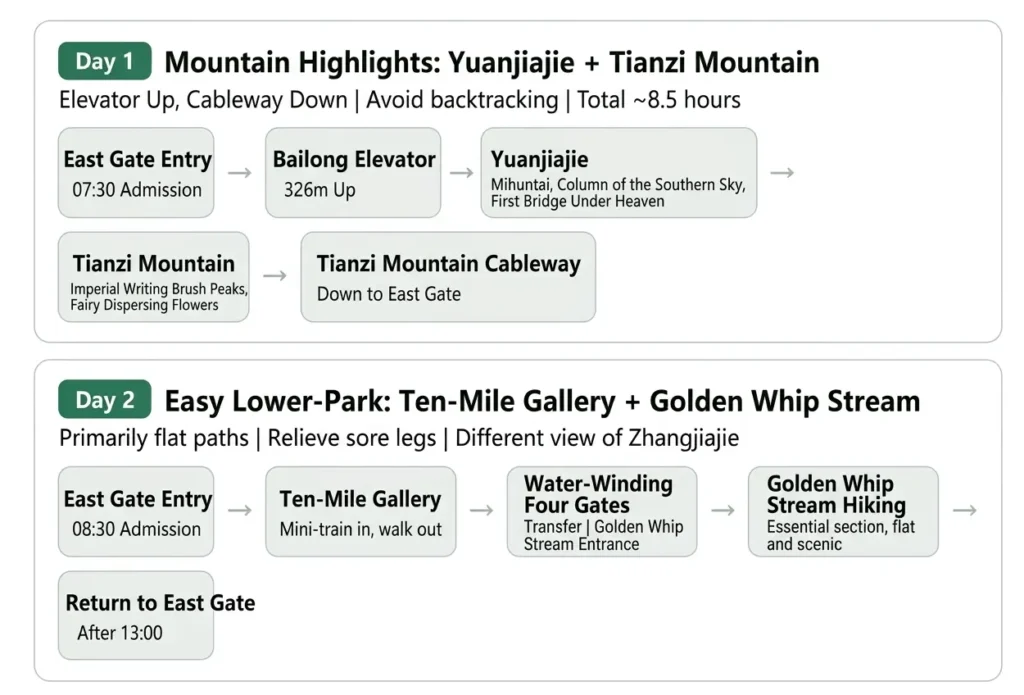
Route Logic: East Gate $\rightarrow$ Bailong Elevator Up $\rightarrow$ Yuanjiajie $\rightarrow$ Eco-shuttle to Tianzi Mountain $\rightarrow$ Tianzi Mountain Cableway Down $\rightarrow$ East Gate Out. This route goes “up by elevator, down by cableway,” avoids backtracking, and saves the most physical energy.
- 07:30 — Park Entry: Scan your passport at the East Gate to enter (first-time visitors must use the manual lane for verification, after which facial recognition can be used). Take the eco-shuttle straight to the lower station of the Bailong Elevator. Remember: every minute you start earlier spares you from waiting in line. Entering before 8:00 AM lets you head up the mountain almost alongside the first rays of morning light, enjoying a quiet, crowd-free forest of stone peaks.
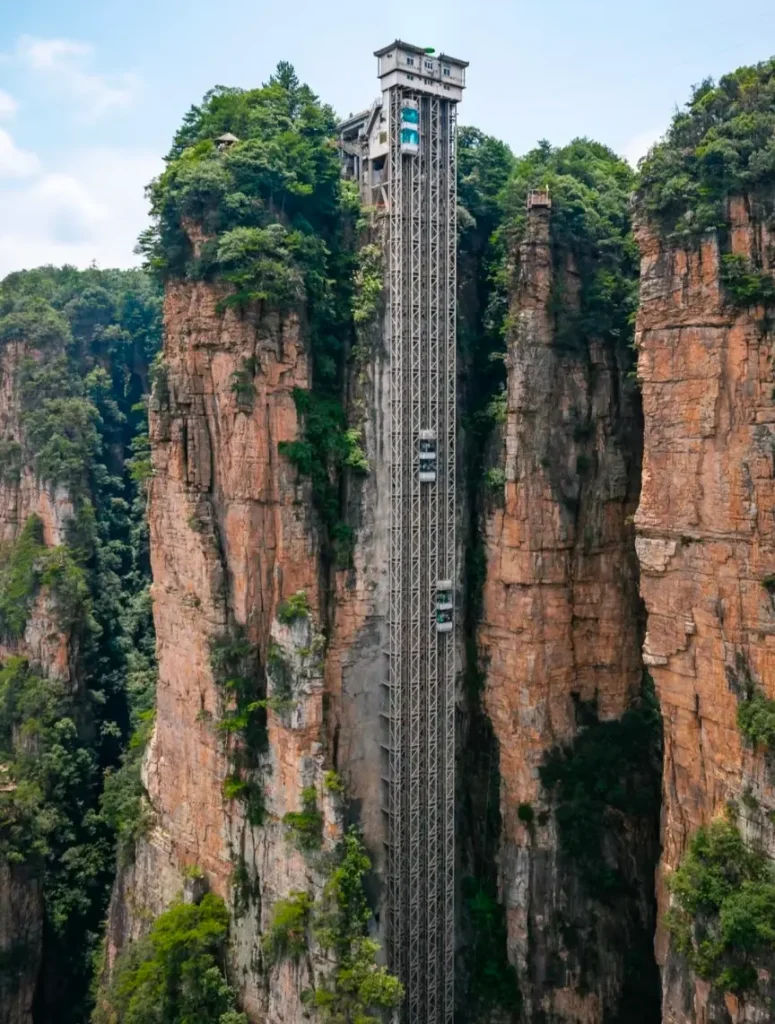
- 08:30 — Bailong Elevator Experience: A 326-meter outdoor glass elevator built vertically against a sheer cliff face, taking about 90 seconds. For first-timers, the ride itself is a wonder—as the elevator shoots to the cliff top, the view outside instantly transforms from stone walls into an endless sea of peaks. Many travelers describe the feeling as “unbelievably fast, holding your breath the moment the scenery appears.” Exit the elevator and take the eco-shuttle to the Mihuntai (Enchanting Platform) station.
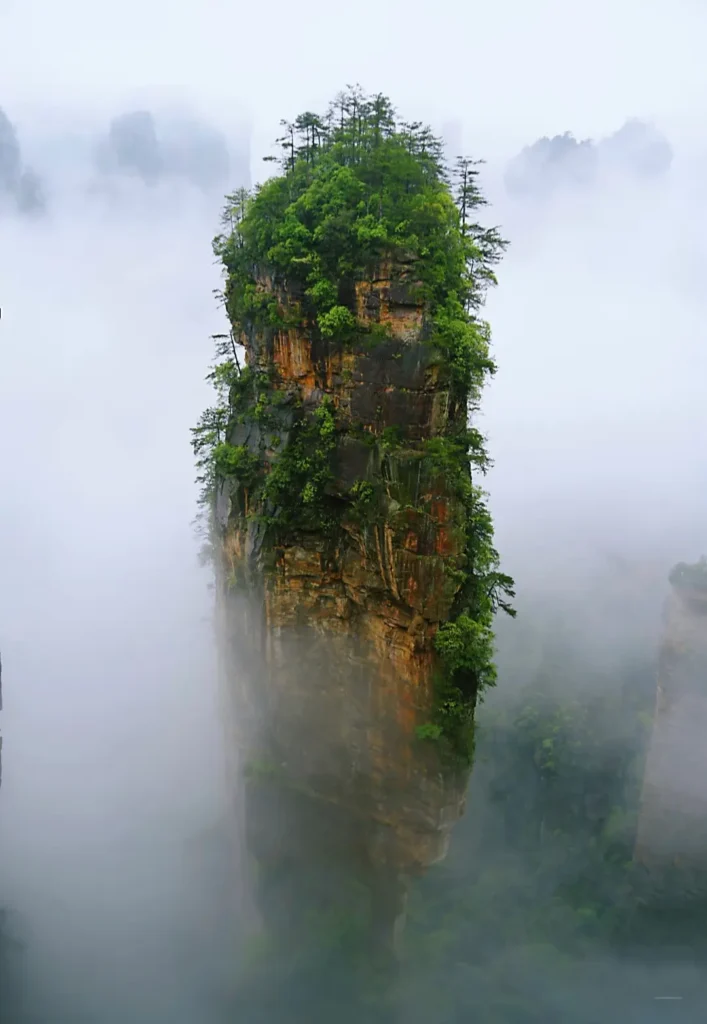
- 09:00 — Yuanjiajie Scenic Area: This is the true climax of the trip and where you will lift your camera countless times over three hours. Walking along the cliffside plank roads, the first stop is Mihuntai—looking down from here, dense clusters of stone pillars resemble a frozen ocean wave spreading from deep valleys to the horizon, leaving you momentarily awestruck at the edge of the precipice. Further ahead is Column of the Southern Sky (Qiankun Column)—a solitary stone pillar rising sharply, its top slightly flared, looking suspended in mid-air when clouds roll by. Yes, this is the prototype of the Hallelujah Mountains in Avatar; seeing it with your own eyes, you might pause in disbelief that something seen countless times in photos is actually this massive, close, and surreal. Finally, reach the First Bridge Under Heaven—a natural stone arch spanning two peaks with a bottomless canyon below. Walking across it gives you the visceral sensation that “this bridge has stood for 380 million years, and you are standing right on it.” Take your time; these three hours are well worth it.
- 12:00 — Lunch: There are plenty of snack stalls and fast-food outlets on the mountain, or you can pack your own picnic food. Dining inside the scenic area is slightly pricey, but convenient—save your appetite, as a better meal awaits tonight.
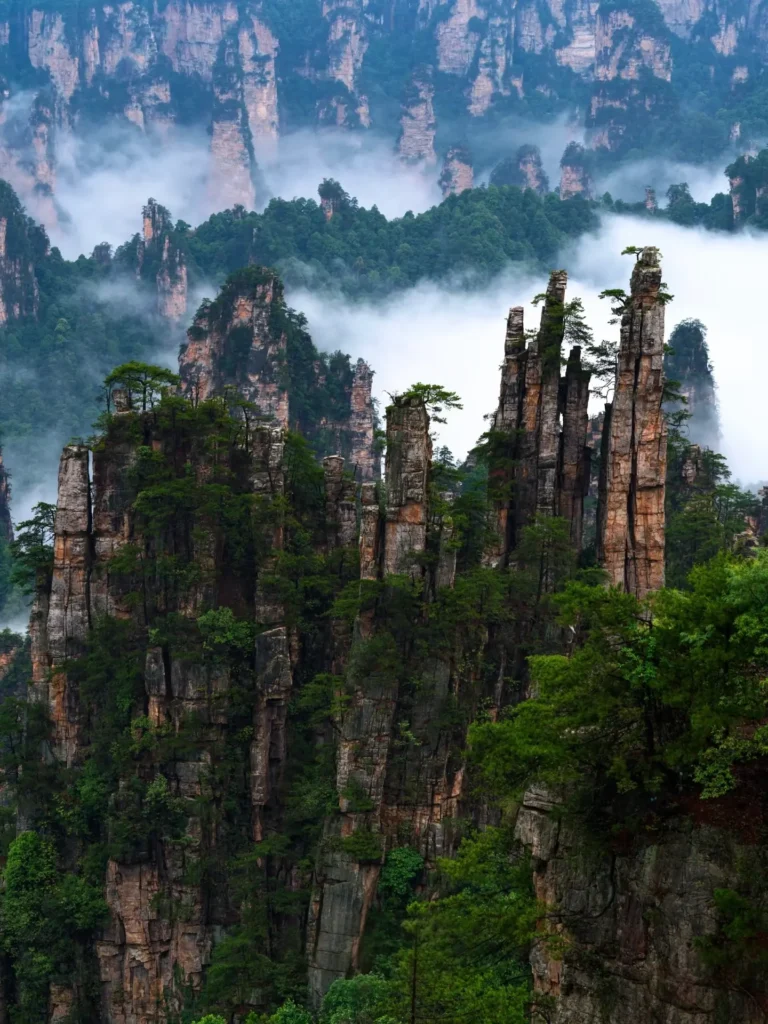
- 13:00 — Tianzi Mountain Nature Reserve: Take the eco-shuttle from the First Bridge station to Tianzi Mountain. If Yuanjiajie is about “walking inside the peak forest,” Tianzi Mountain is about “overlooking a sea of peaks from the sky”—the horizon opens up dramatically, with entire forest peaks spreading beneath your feet like an ocean. Two must-see sights: Imperial Writing Brush Peaks (Yubifeng), the classic postcard view of Zhangjiajie featuring slender stone peaks resembling inverted calligraphy brushes emerging from mist; and diagonally opposite, Fairy Dispersing Flowers, a stone peak resembling a maiden holding a flower basket. You can pass by Helong Park along the way without lingering too long.
- 15:30 — Descending the Mountain: Walk to the Tianzi Mountain Upper Cableway Station and take the cableway down (approx. 70 RMB, about a 6-minute ride), then transfer to the eco-shuttle back to the East Gate. In the late afternoon, the setting sun casts a golden glow over the peaks, providing a final highlight to bookmark your day.
Evening Dining: Enjoying Tujia Three-Down Pot (Sanxiaguo) in Wulingyuan
This is Zhangjiajie’s signature local dish. Originally a hearty celebratory dish for the Tujia ethnic minority during New Year, it has become an everyday street food favorite. Served in a dry-pot style, the core ingredients typically include cured pork, pork intestines, and pork stomach (some restaurants allow substitutions like beef tripe or walnut meat), heavily stir-fried and simmered with ginger, garlic, dried chili peppers, and fermented bean paste. It is savory, spicy, numb, tender, and deeply aromatic. If you enjoy offal, this is the most authentic culinary experience; if not, look for a restaurant that offers a single-meat cured pork pot. There are plenty of options in Wulingyuan Town, so you don’t need to travel back to the downtown area.
Day 2: Exploring Ten-Mile Gallery & Golden Whip Stream
Route Logic: East Gate $\rightarrow$ Eco-shuttle to Ten-Mile Gallery $\rightarrow$ Sightseeing train in, walk out (or round-trip train) $\rightarrow$ Eco-shuttle to Water-Winding Four Gates $\rightarrow$ Golden Whip Stream essential hiking section $\rightarrow$ Return to Water-Winding Four Gates $\rightarrow$ East Gate Out. Today is mostly flat walking, easing yesterday’s sore legs and shifting your perspective from “overlooking from above” to “walking through” the landscape.
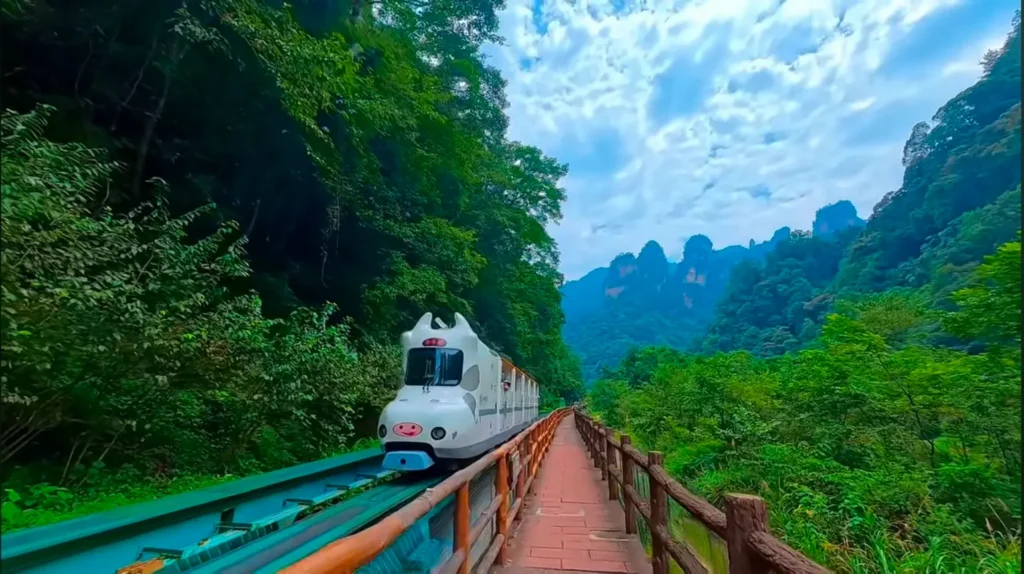
- 08:30 — Ten-Mile Gallery (Shili Hualang): Take the eco-shuttle from the East Gate to the Ten-Mile Gallery station. This is a roughly 5-kilometer canyon flanked by peaks of various shapes, unfolding like a slow-moving scroll painting. It is recommended to take the sightseeing mini-train inward (approx. 38 RMB one-way) and walk back out—the train saves energy, but you would miss the iconic Herb-Gathering Old Man peak (a rock formation resembling an old man carrying a medicine basket) situated mid-way, which can only be fully appreciated while walking back. If you are pressed for energy, taking the train both ways is fine, though you’ll miss some slow-paced rock spotting.
- 11:00 — Transfer: Take the eco-shuttle to Water-Winding Four Gates, which drops you right at one of the entrances to Golden Whip Stream.
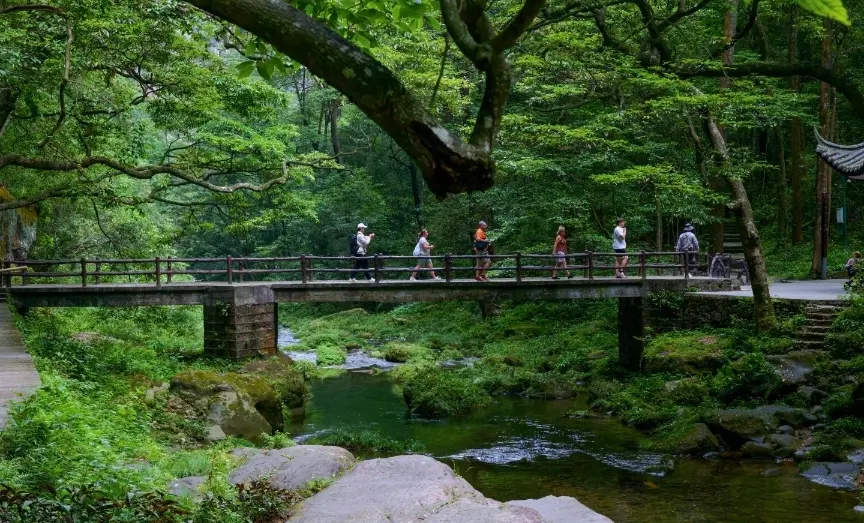
- 11:30 — Golden Whip Stream Hiking Trail: This is a filming location for the 1986 classic TV series Journey to the West. Entirely flat, accompanied by flowing streams and plenty of shade, this is the most relaxing stretch of the two days. However, there is one serious warning to keep in mind: The local macaques are fearless and will snatch food. Do not carry plastic bags in your hands, never eat in front of them, keep your backpack securely zipped, and hold tightly onto your phone and sunglasses. Incidents of monkeys grabbing items from tourists happen frequently—they show no fear of strangers and move with startling speed. Walk as far as you feel comfortable, then simply turn back to Water-Winding Four Gates (the full trail is about 7.5 kilometers and ends far from the East Gate).
- After 13:00 — Return to the East Gate: Take the eco-shuttle from Water-Winding Four Gates back to the East Gate. If you still have time, explore Wulingyuan Town and pick up some local souvenirs. If you need to catch a flight or high-speed train to another Chinese city on the same day, make sure to turn back early on Golden Whip Stream—allow ample time for the transfer from Wulingyuan to the downtown airport or train station (about 40–50 minutes).
3. Essential Practical Tips for International Travelers in Zhangjiajie
Zhangjiajie Passport Verification & Online Ticket Booking
Your passport is your official ticket. The entry time slot and gate must be selected at the time of purchase. Zhangjiajie National Forest Park operates on a real-name, time-slot, and station-specific reservation system.
When purchasing tickets on international platforms like Trip.com or GetYourGuide, you must select three details simultaneously: visit date, entry time slot (e.g., 8:00–9:00 AM), and entry gate. Payment completes your reservation, and entry requires checking in strictly at your booked time and gate. Unreserved entry is not permitted. During peak seasons, same-day tickets often sell out or only have afternoon slots left, so book several days in advance.
On your first entry, use the manual verification lane to present your original passport. Once staff record your details, you can enter and exit seamlessly using facial recognition throughout the 4-day validity period. If your travel plans change, time slots can be modified via the official mini-program.
Zhangjiajie Ticket Options & Cableway Pass Pricing Breakdown
(Subject to On-Site Announcements)
1. Basic Tickets & Eco-Shuttle Combos:
- Standard Ticket Only: 165 RMB/person (Valid for 4 consecutive days; includes park entry only, excludes eco-shuttles, cableways, and elevators).
- Park + Eco-Shuttle Combo: 236 RMB/person (Valid for 4 consecutive days; includes park entry and internal eco-shuttles, excludes cableways, elevators, and the mini-train).
2. Pass Breakdown & Inclusions:
| Pass Type | Reference Price | Inclusions | Includes Park Entry? |
| All-Inclusive Pass (Full Pass) | Approx. 470–518 RMB | Unlimited park entry + unlimited rides on eco-shuttles, 3 cableways, and Bailong Elevator within 4 days. | Yes |
| Multi-Ride Pass | 298 RMB | Unlimited rides on 3 cableways and Bailong Elevator within 4 days. | No (Must purchase 165 RMB park ticket separately) |
| 4-Ride Pass | 238 RMB | Limited to 4 single-ride tickets across the 3 cableways and Bailong Elevator within 4 days. | No (Must purchase 165 RMB park ticket separately) |
Note on Extra Expenses: The Ten-Mile Gallery sightseeing mini-train is not included in the “3 Cableways & 1 Elevator” passes. It costs approximately 38 RMB one-way and requires a separate ticket.
Ticket Buying Advice for a 2-Day Zhangjiajie Itinerary
With only two days to explore on this classic sightseeing route, here is how to choose:
- Budget-Conscious Choice: Purchase the Park + Eco-Shuttle Combo (~236 RMB), then pay individually for the extra rides you need: Bailong Elevator (~72 RMB one-way), Tianzi Mountain Cableway (~70 RMB one-way), and the Ten-Mile Gallery mini-train (~38 RMB one-way).
- Hassle-Free Choice: If you prefer ultimate convenience and unlimited rides without worrying about individual tickets, purchase the All-Inclusive Pass directly.
How to Get from Zhangjiajie Airport (DYG) to Wulingyuan
Zhangjiajie Hehua Airport has no direct shuttle bus to Wulingyuan. The most hassle-free option is a taxi or ride-hailing car (approx. 80–120 RMB, 40–70 minutes); alternatively, take the airport shuttle into downtown (approx. 10 RMB) and transfer to a regional bus. If Wulingyuan is your first stop and you are carrying heavy luggage, book an airport pickup or taxi in advance rather than wasting your first day on transit.
Overcoming the Language Barrier in Zhangjiajie
Eco-shuttle announcements are in Chinese only, and English names on signboards might not match your map app. A practical strategy: write down the names of your destinations (e.g., “水绕四门”, “百龙天梯”) in Chinese characters on paper or your phone notes and show them directly to drivers or staff when boarding. Download an offline translation app and show your phone screen when ordering in restaurants—it is far more effective than sign language.
Mobile Payments & Connectivity for Foreign Tourists in China
Setting up Chinese mobile payment apps with foreign credit cards can sometimes be tricky; consider arranging a tourist communication and payment solution upon arrival at the airport. Most vendors in the scenic area accept digital QR codes, but always carry some cash just in case.
What to Wear: Essential Footwear for Zhangjiajie Hiking
The forest park consists almost entirely of stone slab steps, especially numerous on the first day in the mountains. A comfortable pair of slip-resistant athletic shoes matters more than any travel guide.
4. Other Zhangjiajie Attractions Worth Exploring Next Time
Making trade-offs for a classic Zhangjiajie 2-day itinerary means you deliberately bypassed a few equally stellar spots. Knowing they exist may give you a reason to return.
- Tianmen Mountain: Another independent and popular scenic area in Zhangjiajie, famous for Tianmen Cave (the world’s highest naturally occurring mountain arch) and the cliffside glass skywalk hanging roughly 1,430 meters above sea level (about 60 meters long). It offers a completely different experience from the Forest Park: the Forest Park showcases peak forests, while Tianmen Mountain features caves, skywalks, and the breathtaking hairpin turns of the Tongtian Avenue mountain road. If you have 3 to 5 days next time, Tianmen Mountain deserves a full dedicated day.
- Zhangjiajie Grand Canyon: Also worthy of your future list, most famous for its Glass Bridge—a transparent suspension bridge spanning the canyon, about 430 meters long and 300 meters above the valley floor, with deep gorges and streams directly beneath your feet. Note that this is different from Tianmen Mountain’s glass skywalk (which hugs a cliff face at 1,430m altitude); one is a bridge across a canyon, the other is a trail clinging to a cliff. If you love high-altitude thrills, both are top-tier Zhangjiajie experiences.
- Huangshizhai (Yellow Stone Village): There is a local saying: “He who has not climbed Huangshizhai has not truly visited Zhangjiajie.” It is one of the earliest developed and most concentrated scenic areas in the Forest Park, where a circular viewing platform reveals panoramic views of three thousand wondrous peaks. However, climbing Huangshizhai requires an extra half-day, making it a reasonable omission for a two-day itinerary.
- Yangjiajie Scenic Area: Known for its dramatic peak-wall formations, particularly the “Natural Great Wall”—dozens of parallel stone walls resembling defensive ramparts built by nature itself. Some sections require backtracking and demand high physical stamina, making it ideal for hikers and explorers. If you have 3 to 4 days next time, Yangjiajie is well worth exploring in depth.
5. Final Thought: Making the Most of Your Zhangjiajie 2-Day Itinerary
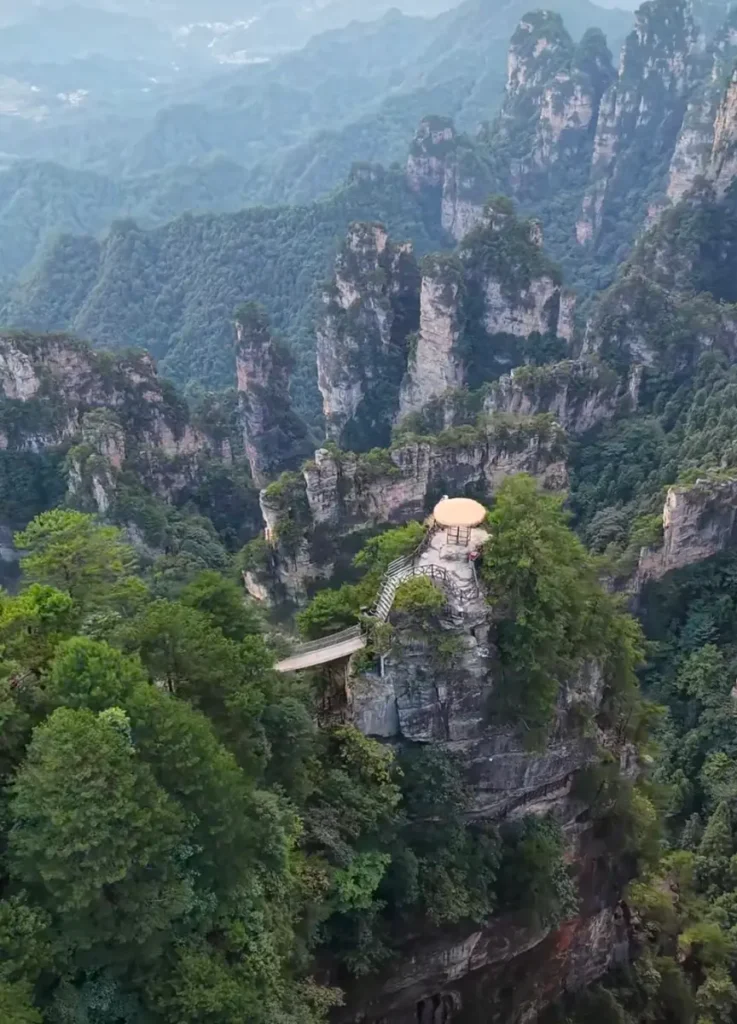
You only have two days, and Zhangjiajie is massive. But that doesn’t mean regret. The Column of the Southern Sky in Yuanjiajie, the Imperial Writing Brush Peaks in Tianzi Mountain, and the river valley of Golden Whip Stream—these three elements already constitute the most irreplaceable experiences of Zhangjiajie National Forest Park.
Lingering a few extra minutes in front of the Column of the Southern Sky is far more rewarding than rushing off to snap a hurried photo at the next viewpoint. Enjoy the journey you came so far to take.