A Journey into Baiyun Temple, Beijing: The Blessing Codes and Oriental Wisdom of a Millennial Daoist Temple
Just outside Xibianmen Gate in Beijing’s Xicheng District, a thousand-year-old Daoist temple defined by red walls and grey tiles stands quietly—this is Baiyun Temple (White Cloud Temple). Revered as the “Foremost Monastery of Quanzhen Daoism”, it is the ancestral temple of the Dragon Gate sect, known for harmonizing Taoist philosophy, folk belief, and traditional culture. For foreign visitors, Baiyun Temple offers a glimpse into the mystical charm of Chinese Daoism and the tranquil rhythm of old Beijing life.

History of Baiyun Temple, Beijing
Baiyun Temple, originally built during the Tang Dynasty, was first called Tianchang Temple, dedicated to the worship of Laozi, founder of Taoism. During the Jin Dynasty, it was renamed Taiji Palace. In the Yuan Dynasty, the famous Daoist master Qiu Chuji (Changchun Zhenren) lived here and was later summoned by Genghis Khan to preach in the west—an event that made the temple widely known.
The temple took its current name, Baiyun Temple (White Cloud Temple), after a major reconstruction in the early Ming Dynasty. It flourished under the Qing emperors, becoming one of the most important Daoist temples in Beijing. Today, it serves as the headquarters of the Chinese Daoist Association, preserving millennia of spiritual heritage and continuing the living tradition of Quanzhen Daoism.

Daoist Temple vs. Buddhist Temple: A Harmony of Faith and Space
Unlike Buddhist temples, Daoist temples such as Baiyun Temple enshrine Daoist deities like the Three Pure Ones (Sanqing) and the Four Emperors (Siyu) instead of Buddhas. Architecturally, Daoist temples emphasize the philosophy of “Harmony between Heaven and Humanity” (Tian Ren He Yi), unfolding symmetrically along a central axis and blending the serenity of gardens with the majesty of palaces.
In Baiyun Temple, the Three Pure Ones Pavilion houses statues on the upper floor, while the Four Emperors Hall below represents the cosmic hierarchy of the Daoist universe. Morning and evening chanting, bell ringing, and quiet meditation reflect the Taoist pursuit of internal balance and unity with nature—a contrast to the ritualized devotion found in Buddhist monasteries.

The Secret of Abundant Incense: Modern Interpretations of Taoist Blessings
Baiyun Temple’s enduring popularity lies in its inclusive blessing culture, where locals and travelers alike come to pray for health, wisdom, and good fortune:
- Health and Peace: The Jade Emperor Hall, flanked by Ming Dynasty bronze Heavenly Masters, attracts devotees seeking protection and peace.
- Career and Academics: The Wenchang Hall, dedicated to the God of Literature, is favored by students and professionals. The old plaque “Langjian Zhenting”, said to be inscribed by Emperor Kangxi, represents true learning and wisdom.
- Love and Family: The Tianfei Hall (Goddess of Progeny) is popular for prayers related to marriage and fertility.
- Wealth and Fortune: The Hall of the God of Wealth enshrines Bi Gan, honored as a symbol of fairness and integrity. Merchants often offer incense here to invite prosperity.

Visitor Must-Do Experiences: Touch, Pray, and Discover
- Find the Three Stone Monkeys: Hidden at the Mountain Gate, the Eight-Character Wall, and the East Courtyard stele base, these tiny stone monkeys are said to bring good luck when touched.
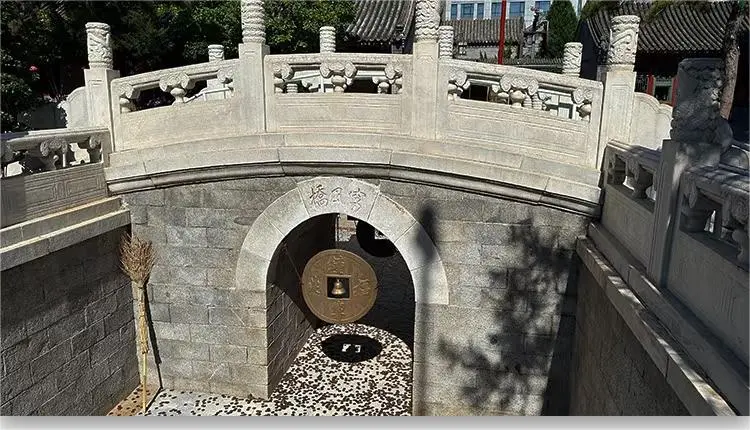
- Toss Coins at the Money Eye: Near the Wo Feng Bridge, visitors throw coins toward a bell under the arch—success symbolizes wealth and fortune.
- Touch the Dragon Cauldron: In the courtyard of the Three Pure Ones Pavilion, visitors gently touch the dragon’s head on a gilded bronze cauldron to pray for abundance.
- Experience the Yanjie Festival Fair: Held annually on the 19th day of the first lunar month (Master Qiu Chuji’s birthday), this festival features folk performances, temple rituals, and local snacks, attracting thousands of visitors.

Souvenir Selection Guide: Spiritual Symbols with Style
- Blessing Talismans: Tai Sui Sachets (for zodiac conflicts), Incense Ash Beads (for peace), and Fortune Amulets.
- Cultural & Creative Gifts: Wenchang Pagoda Models, Lucky Deity Blind Boxes, and stationery printed with Taoist symbols.
- Intangible Heritage Crafts: Replicas of Zhao Mengfu’s Dao De Jing inscriptions and bookmarks inspired by the Ming Daoist Canon.
- Practical Souvenirs: The Money Rice Jar (Zhao Cai Mi Gang), believed to bring prosperity to one’s household.
Practical Information
- Address: No. 7 Baiyunguan Street, Xicheng District, Beijing.
- Opening Hours: 8:30 AM–4:30 PM.
- Admission: ¥10.
- Transportation: Take Subway Line 2 to Changchunjie Station, then Bus No. 26 to Baiyunguan Station.
Conclusion
The charm of Baiyun Temple lies in its dual identity—as both a guardian of ancient Daoist wisdom and a living part of modern Beijing life. Here, the sound of temple bells mingles with the city’s rhythm; faith coexists with daily life. For travelers, it’s not just a historical site—it’s a quiet sanctuary to slow down, breathe, and let the ancient Daoist spirit whisper its timeless story through the wind and incense. For more inspiration, explore other highlights on our Beijing Tourist Attractions page.