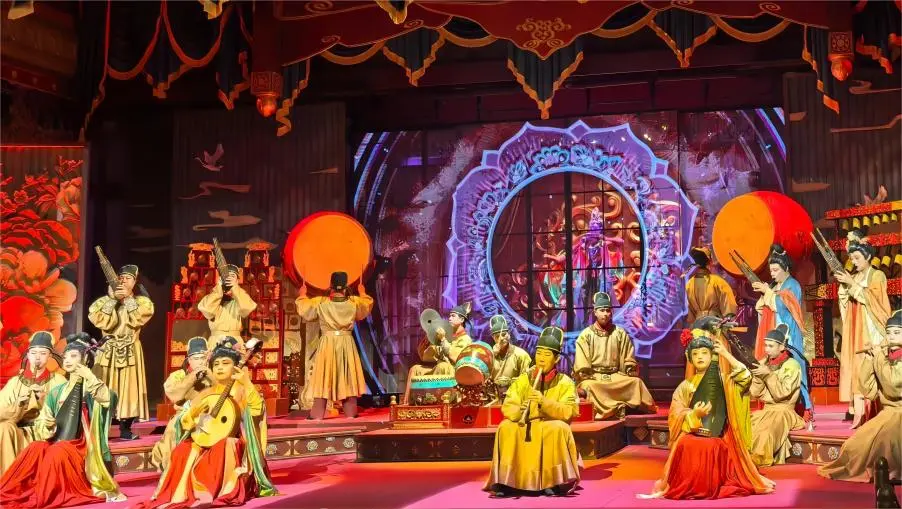
Discover Xi’an Drum Music: China’s Ancient Symphony Still Beating Today
As you walk beneath the towering City Wall of Xi’an, one of China’s most historic cities, you might hear flutes whispering through the air and drums echoing from afar.
This is Xi’an Drum Music (Xi’an Guyue) — a living link to the Tang Dynasty’s royal court and one of UNESCO’s Masterpieces of the Oral and Intangible Heritage of Humanity.
It’s more than music; it’s the heartbeat of Chinese civilization that has continued for over a thousand years.

I. The History of Xi’an Drum Music: From Tang Court to Folk Tradition
The origins of Xi’an Guyue trace back to the Sui and Tang Dynasties (6th–10th centuries), when it flourished as Tang Court Music (Yan Yue), performed during grand imperial banquets.
After the An Lushan Rebellion, court musicians were dispersed among the people, allowing this music to evolve and blend with local life.
Over time, three main branches emerged:
- Buddhist Branch (Seng Pai) – bright, spirited, and often played by monks or laypeople.
- Taoist Branch (Dao Pai) – serene and elegant, preserved mainly in temples like the City God Temple.
- Secular Branch (Su Pai) – robust and earthy, incorporating folk rhythms and street traditions.
By the Ming and Qing dynasties, drum music became a central part of Xi’an’s cultural festivals. At its peak in the 1930s, hundreds of ensembles gathered at the foot of the Zhongnan Mountains, performing for days and nights in celebration.
Although war and modernization threatened its survival, Xi’an Drum Music was revived in the 21st century through intangible heritage programs, museum initiatives, and educational outreach.
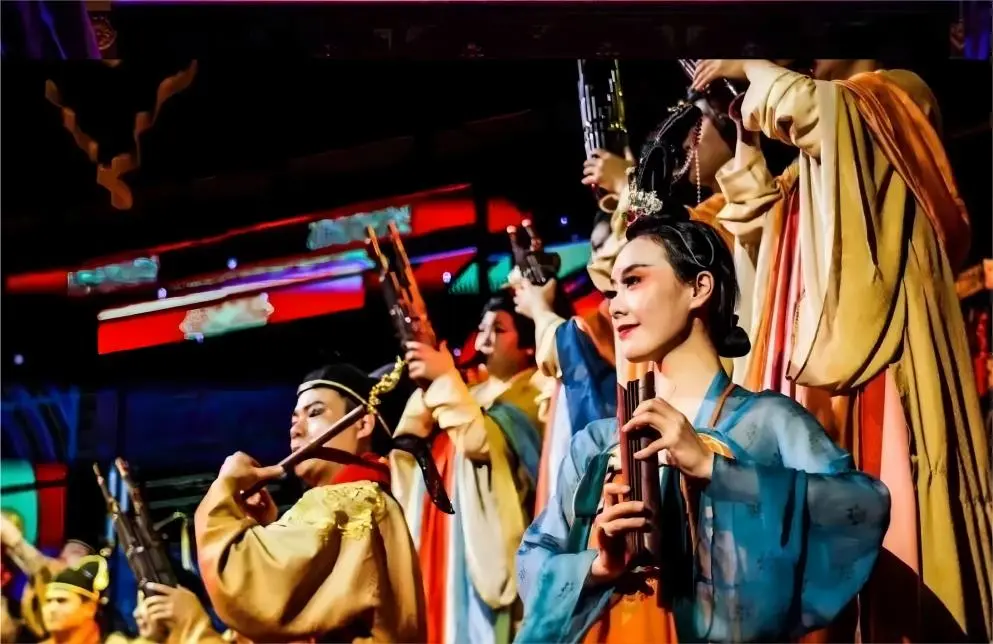
II. What Makes Xi’an Drum Music Unique: Instruments, Styles, and Famous Pieces
Unlike many folk traditions, Xi’an Guyue preserves a complete musical system with over 1,100 pieces. It combines Sitting Music (Zuoyue), performed indoors, and Marching Music (Xingyue), used in parades and festivals.
The ensemble features a variety of instruments:
bamboo flutes (dizi), sheng (mouth organ), guan (double-reed pipe), yunluo (cloud gong), and war drums. Together they create a multi-layered, symphonic texture unique to ancient Chinese music.
🎶 Representative Masterpieces to Know:
- Taoci — A grand suite comparable to a Western symphony, moving from solemn palace rhythms to lively folk melodies.
- Gu Duanzi — Lively and rhythmic, this short piece is often performed during parades, symbolizing everyday joy.
- Da Zhazi — A pure percussion classic that captures the intensity of ancient battle scenes — often called China’s percussion rhapsody.
🎧 Insider tip: Some music societies in Xi’an offer beginner-friendly workshops where visitors can try basic drum rhythms or play a “yunluo” gong — a great way to feel the ancient beat for yourself.

III. Where to Experience Xi’an Drum Music Live
To truly appreciate this ancient sound, you need to see and hear it performed live.
Here are the best places in Xi’an to experience the magic of Xi’an Guyue:
- 🏯 Tang Paradise (Dongcang Drum Music Society) – Daily performances of The Drum, a large-scale show blending holographic projection and live court music. Don’t miss the iconic “Song of the Rainbow Skirt and Feathered Dress.”
- 🕍 City God Temple (Duchenghuangmiao) – The heart of the Taoist tradition, with handwritten Ming-era scores still used today. Free public performances every Saturday feature sacred pieces like Liu Diao Pu Tian Yue (Six Tone Universal Joy).
- 🪶 Zhouzhi Jixian Music Society – A UNESCO-recognized “living musical fossil” in rural Xi’an, where local farmers keep ancient melodies alive. Their Chi Diao Sitting Music Complete Set retains the most authentic rhythm of agrarian life.

IV. Xi’an Drum Music Travel Tips and Festivals
- Best Time to Visit:
Plan your trip around the Zhongnan Mountain Drum Music Festival (first day of the sixth lunar month) or the Spring Festival Intangible Heritage Exhibition at Grand Tang Everbright City. - Interactive Experiences:
Some local societies and museums offer short lessons or participatory workshops — book in advance for a truly immersive experience. - Where to Learn More:
Visit the Xi’an Drum Music Museum or the Hejiaying Drum Music Exhibition Hall, which display Tang-era score replicas and rare instruments — true three-dimensional textbooks of Chinese musical heritage.
Conclusion: The Ancient Beat of Modern Xi’an
When you leave Xi’an, you might find its rhythm echoing in your mind — the fluttering of the bamboo flute, the deep pulse of the war drum, and the timeless harmony of sound and philosophy.
Xi’an Drum Music is not just a preserved tradition; it’s a living bridge between China’s glorious past and its vibrant present.
So next time you explore Xi’an — beyond the Terracotta Warriors and City Wall — pause to listen to the city’s ancient heartbeat.
That’s the sound of history, still alive.
Discover more in our Xi’an Tourist Attractions Collection and China Cultural Heritage Tours Collection to plan your journey.