Summer Palace Beijing: A Journey Through History & Eastern Aesthetics
As the morning sun rises over Longevity Hill and the surface of Kunming Lake shimmers, the Summer Palace (Yiheyuan) unfolds like a vast scroll of landscape painting. Covering 297 hectares, this imperial garden is the largest and best-preserved of its kind in China. Today, it stands not only as a UNESCO World Heritage Site but also as a masterpiece that embodies Chinese philosophy, architecture, and aesthetics.
Summer Palace History: A Scroll of Power and Poetry
The Summer Palace Beijing began in 1750 as the Garden of Clear Ripples (Qingyi Yuan), built by Emperor Qianlong to celebrate his mother’s birthday. Inspired by West Lake in Hangzhou, it combined northern mountains with southern garden elegance.
In 1860, the garden was burned down during foreign invasion. Nearly three decades later, Empress Dowager Cixi rebuilt it using navy funds, renaming it the Summer Palace. It became the most important stage of late Qing diplomacy. Western culture also left its mark here: in the Hall of Joyful Longevity (LeShou Tang), American painter Katharine Carl painted Cixi’s portrait, surrounded by 85 ticking Western clocks—symbols of East and West in dialogue.

The Perfect Balance of Architecture and Nature
Longevity Hill: Climbing for the View
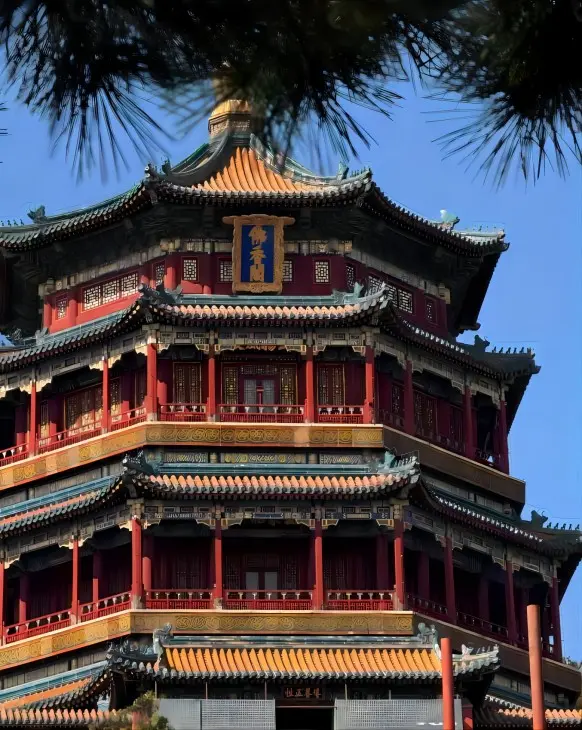
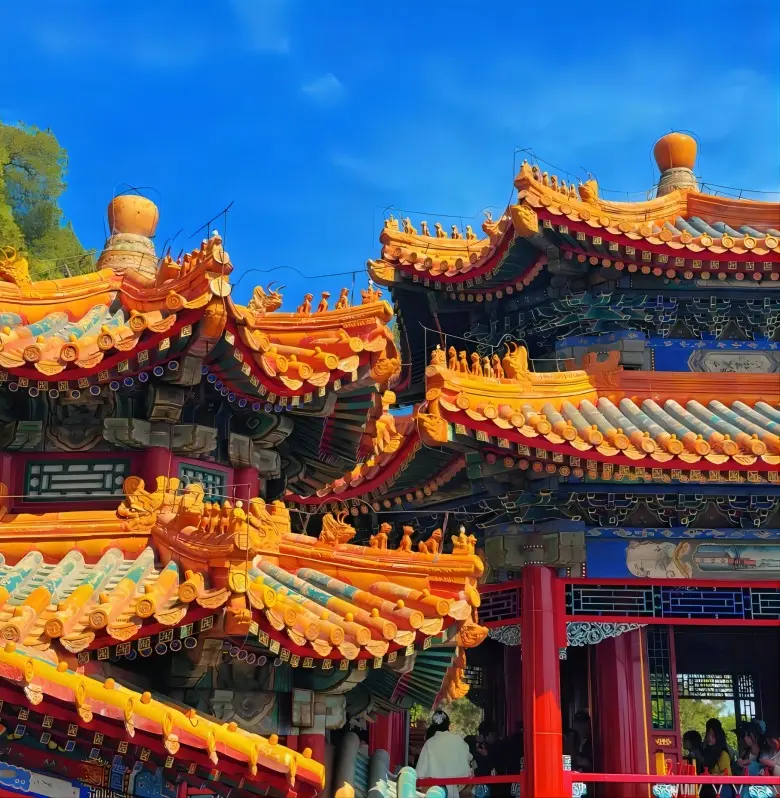
At the summit, the Tower of Buddhist Incense (Fo Xiang Ge) rises like a lotus flower. From here, Kunming Lake glitters like jade, with three islands symbolizing the mythical “One Pool, Three Mountains.” Midway up, the Four Great Regions echo Tibetan temples, with 108 white stupas representing Mount Meru in Buddhist cosmology.
Kunming Lake: Sailing Through Time
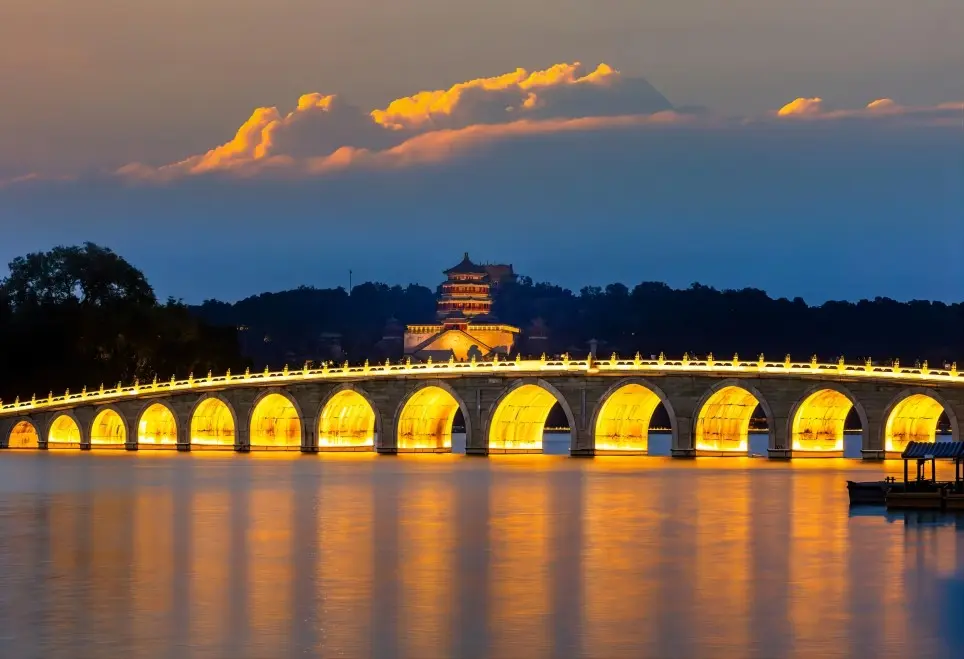
A boat ride reveals the harmony of water and architecture. The iconic Seventeen-Arch Bridge curves across the lake, lined with 544 stone lions. In winter, the light shining through its arches creates the famed “Golden Light Piercing the Arches,” a photographer’s dream. The West Causeway, modeled after Hangzhou’s Su Causeway, connects six graceful bridges, with blossoms in spring and reeds in autumn evoking a southern water village.
The Long Corridor: An Open-Air Art Gallery
Stretching 728 meters, the Long Corridor is the longest painted corridor in the world. Its 14,000 vivid paintings illustrate classics like Romance of the Three Kingdoms and Dream of the Red Chamber. As you stroll, you’ll encounter mythical scenes—such as Chang’e flying to the Moon—alongside subtle historical references hidden in the beams.
Cultural Codes of Eastern Wisdom
LeShou Tang: Cixi’s Residence of Power
The Hall of Joyful Longevity was Empress Dowager Cixi’s private retreat, themed around “Wealth and Status.” Magnolias, crabapples, and peonies filled the courtyard, while 12 glass-panel screens softened the sunlight into golden hues. Inside, purple sandalwood screens, gilded burners, and even yellow satin Western sofas reflected both imperial grandeur and the court’s ambivalence toward Western influence.
Deheyuan Grand Stage: The Heart of Peking Opera
The Deheyuan Grand Stage, at 21 meters tall, is the largest imperial theater in China. Ingenious winch systems created stage illusions, from immortals ascending to gods appearing in the clouds. When Cixi attended performances here, scripts were altered to glorify the empress dowager. The theater’s sound absorption and underground water storage still astonish modern architects.
Travel Tips for Visiting the Summer Palace
- Best Season: April–May for peach blossoms, October–November for golden autumn leaves, and winter for snow scenes that resemble ink paintings.
- Hidden Route: Enter from the North Palace Gate → stroll through Suzhou Street → climb to the Four Great Regions → reach the Tower of Buddhist Incense → walk the Long Corridor → view the Marble Boat → boat to South Lake Island → cross the Seventeen-Arch Bridge → exit at the New Palace Gate. This route avoids most tour groups.
- Cultural Bonus: Every Tuesday at 10:00 AM, enjoy Peking Opera performances at the Deheyuan Grand Stage, showcasing traditional Chinese theater.
- Photography Secret: Capture the full expanse of Kunming Lake from the Hall of Embracing the Universe at sunrise. At sunset, photograph the “Golden Light Piercing the Arches” from the south side of the Seventeen-Arch Bridge.
For detailed planning advice, see our upcoming Summer Palace Travel Guide with ticketing, entrances, and insider tips.
Summer Palace in the Heart of Beijing Attractions
The Summer Palace Beijing is a crown jewel among Beijing tourist attractions, alongside the Forbidden City and the Temple of Heaven. For another imperial masterpiece shaped by history and landscape, don’t miss the Badaling Great Wall.
As the sun sets, gilding the Tower of Buddhist Incense and reflecting over Kunming Lake, the Summer Palace invites travelers to step into a living painting of Eastern aesthetics. As UNESCO described: “The Summer Palace is a masterpiece of Chinese landscape garden design. The harmonious integration of man’s handiwork and nature is exemplary.”
The pines of Longevity Hill are calling—are you ready to be part of this timeless masterpiece?