Tianmen Mountain Attractions: Glass Skywalk, Tianmen Cave & Beyond
Visiting Zhangjiajie for the first time and wondering where to start? Just keep this simple formula in mind: 3 Major Scenic Areas (Wulingyuan, Tianmen Mountain, Zhangjiajie Grand Canyon) + 1 Downtown Area. This guide focuses specifically on Tianmen Mountain.
Tianmen Mountain and Wulingyuan’s core Zhangjiajie National Forest Park are often lumped together by visitors, but they are actually two completely independent mountain systems. While the National Forest Park is famous for its 3,000 quartz-sandstone pillars, Tianmen Mountain is defined by three iconic spectacles: a massive natural cave piercing through the mountain, sheer cliffside pathways, and a cableway flying straight from the downtown area to the summit.
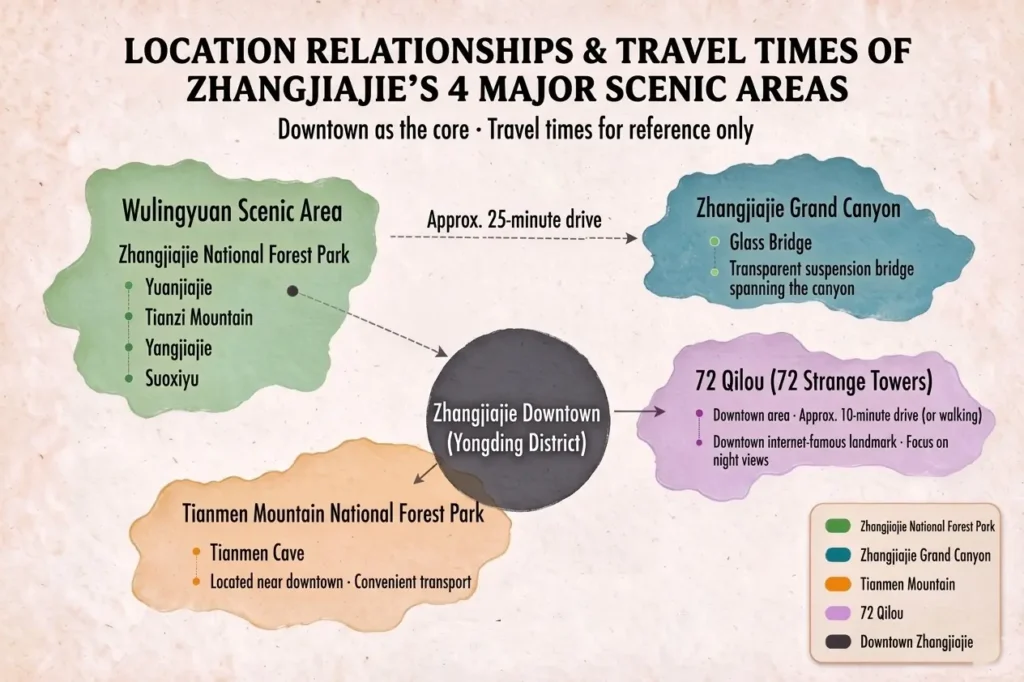
Located just 8 kilometers from downtown Zhangjiajie, Tianmen Mountain was historically called Yunmeng Mountain or Songliang Mountain. In 263 AD, a massive section of the cliff collapsed to form a natural mountain arch, prompting King Sun Xiu of the Wu State to officially bestow the name “Tianmen Mountain” (Heaven’s Gate Mountain). With its main peak—Yunmeng Fairy Summit—sitting at an elevation of 1,518.6 meters, it is celebrated as the “First Divine Mountain in Western Hunan” and the “Soul of Zhangjiajie.” In this guide, we will break down everything worth seeing at Tianmen Mountain along the exact route you will actually walk.
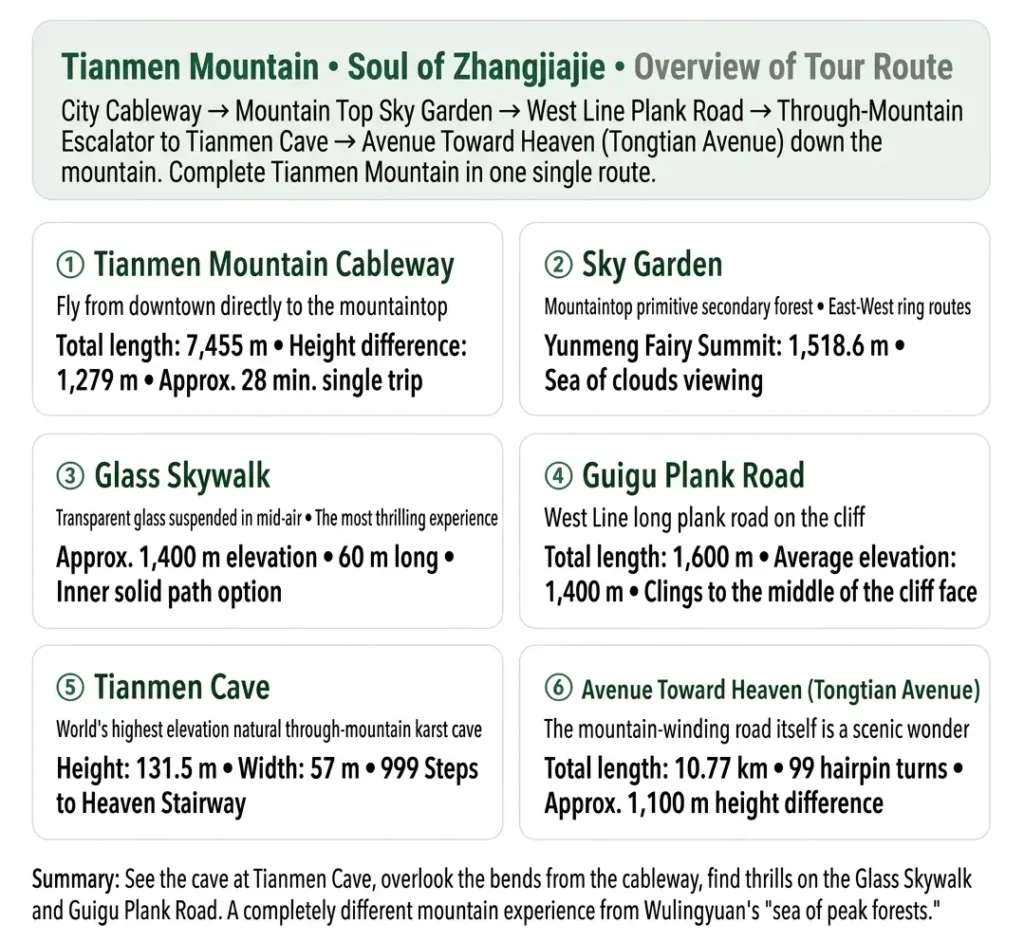
The core experience of Tianmen Mountain is concentrated into four major wonders: Tianmen Cave, the Avenue toward Heaven (Tongtian Avenue), the Tianmen Mountain Cableway, and the Bonsai Garden in the Sky. Let’s go through them one by one—though this itinerary follows your actual movement flow: Downtown Cableway Up → Summit Bonsai Garden → West Line Plank Road (Glass Skywalk & Ghost Valley Plank Road) → Through-Mountain Escalator Down to Tianmen Cave → Tongtian Avenue Down. Following this sequence ensures you hit all four major wonders in the smoothest possible order.
1. Tianmen Mountain Cableway: What to Expect from the World’s Longest Cable Car
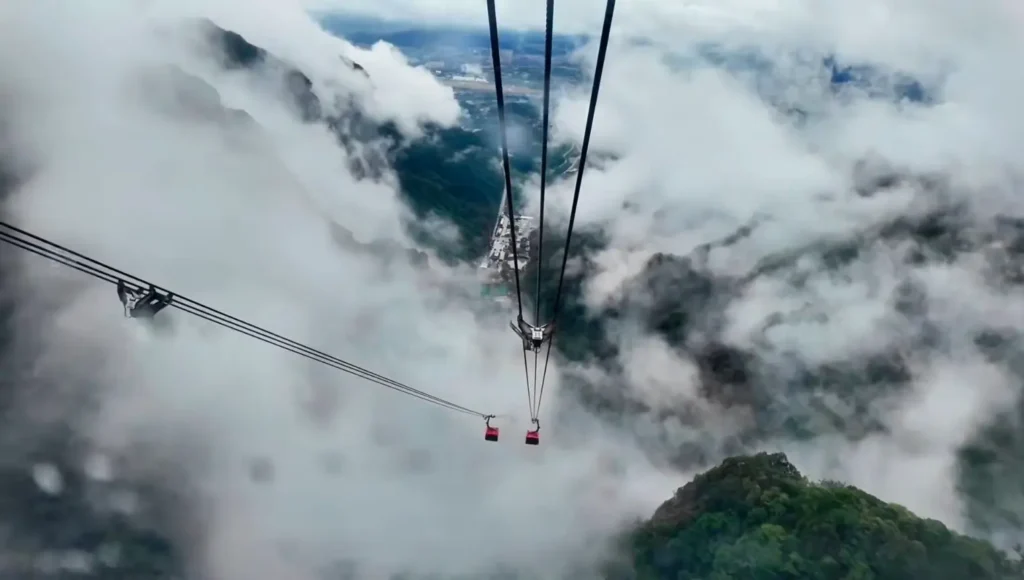
Spanning 7,455 meters with a vertical ascent of 1,279 meters, the Tianmen Mountain Cableway is one of the longest high-altitude passenger cableways in the world with a single continuous loop. Its most unique feature is the starting point: rather than being tucked away deep in the mountains, it departs directly from downtown Zhangjiajie right next to the railway station, whisking you up to the summit in about 28 to 30 minutes. As the cable car climbs, the cityscape shrinks beneath your feet, the hairpin turns of Tongtian Avenue gradually unfold, and towering cliffs and stone forests rush toward you. For many travelers, this single cableway ride alone is worth the ticket price. It is the standard first step for most visitors—fly straight to the top, then explore at your own pace.
2. Tianmen Mountain Summit: Exploring the Bonsai Garden in the Sky
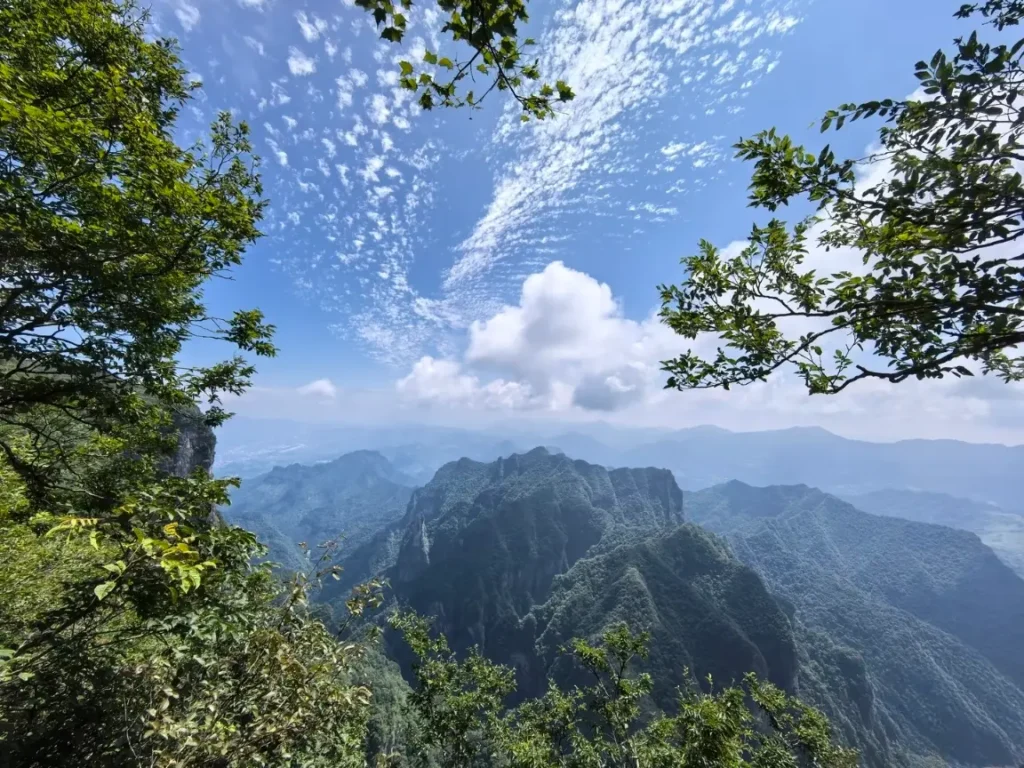
Many assume Tianmen Mountain is purely steep and sheer, but the summit opens up into a surprisingly vast, relatively flat plateau. It preserves an intact primitive secondary forest, resembling a suspended garden in the clouds—hence the name “Bonsai Garden in the Sky.” The Yunmeng Fairy Summit, standing at 1,518.6 meters, is the highest point in Yongding District, offering sweeping views of rolling sea-of-clouds phenomena beneath your feet on clear days. The summit tour is split into two loops: the West Line, packed with thrilling cliffside walkways and viewing platforms, and the East Line, which winds through primitive forest belts like the Dove Tree Garden and offers a much quieter atmosphere. Most travelers choose to invest the majority of their time on the West Line.
3. Tianmen Mountain Glass Skywalk & Ghost Valley Plank Road
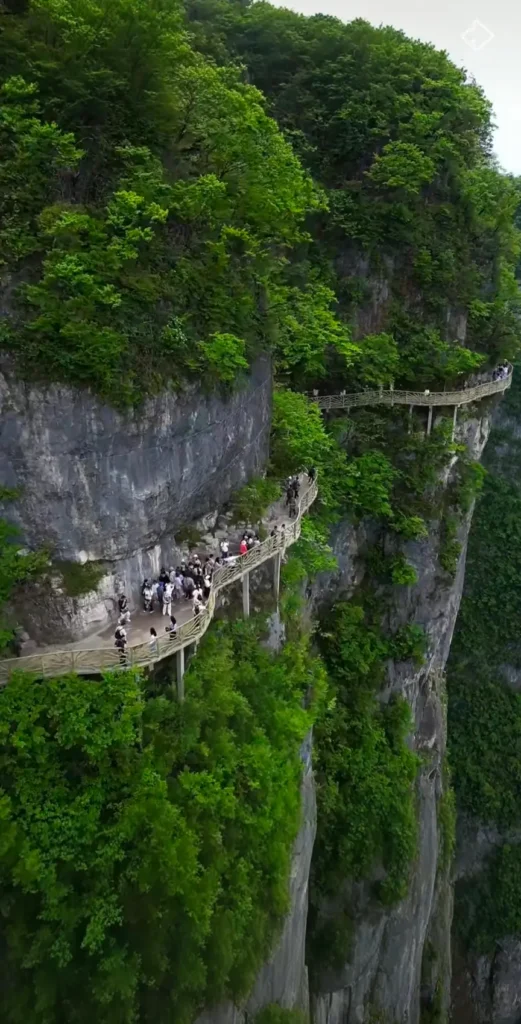
A series of suspended wooden walkways cling to the vertical cliffs surrounding the summit, with the most famous being the Glass Skywalk and the Ghost Valley Plank Road, both located on the West Line.
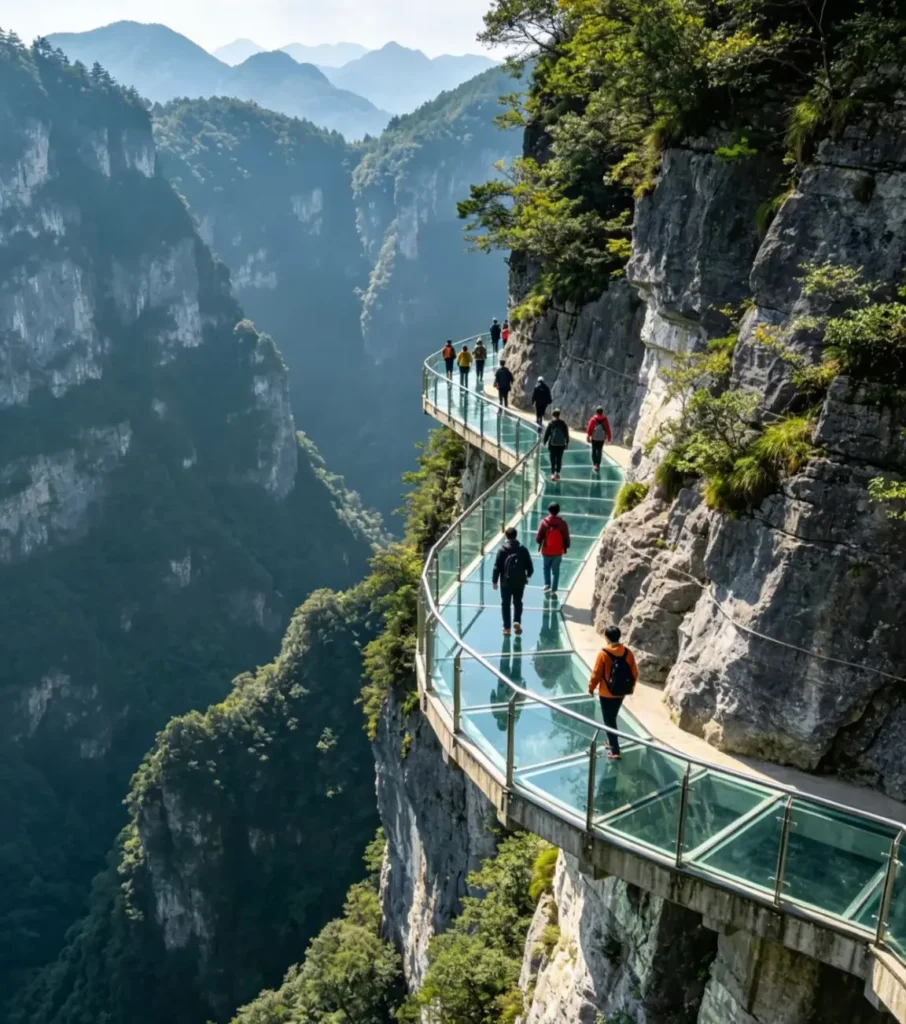
- The Glass Skywalk is built along a sheer cliff at an altitude of about 1,400 meters. Spanning 60 meters long, it features transparent glass flooring with a sheer drop far below, making it Tianmen Mountain’s original cliffside glass walkway. Travelers with a severe fear of heights do not need to force themselves—you can simply walk along the solid inner pathway next to the rock face without stepping onto the glass.
- The Ghost Valley Plank Road is a much longer cliffside trail on the West Line, stretching about 1,600 meters at an average altitude of 1,400 meters, running from Yihong Pass to Xiaotianmen. What makes it truly unique is that it neither clings to the very top nor rests against the base of the cliff; instead, it is bolted directly into the middle of a thousand-foot vertical precipice. Walking it gives you the surreal sensation of rising and falling with the cliff face while flying alongside the mountain. It feels somewhat “gentler” than the glass walkway, but offers grander vistas and frequently rewards hikers with post-rain sea-of-clouds scenery.
4. Tianmen Cave (Heaven’s Gate) and the 999 Steps
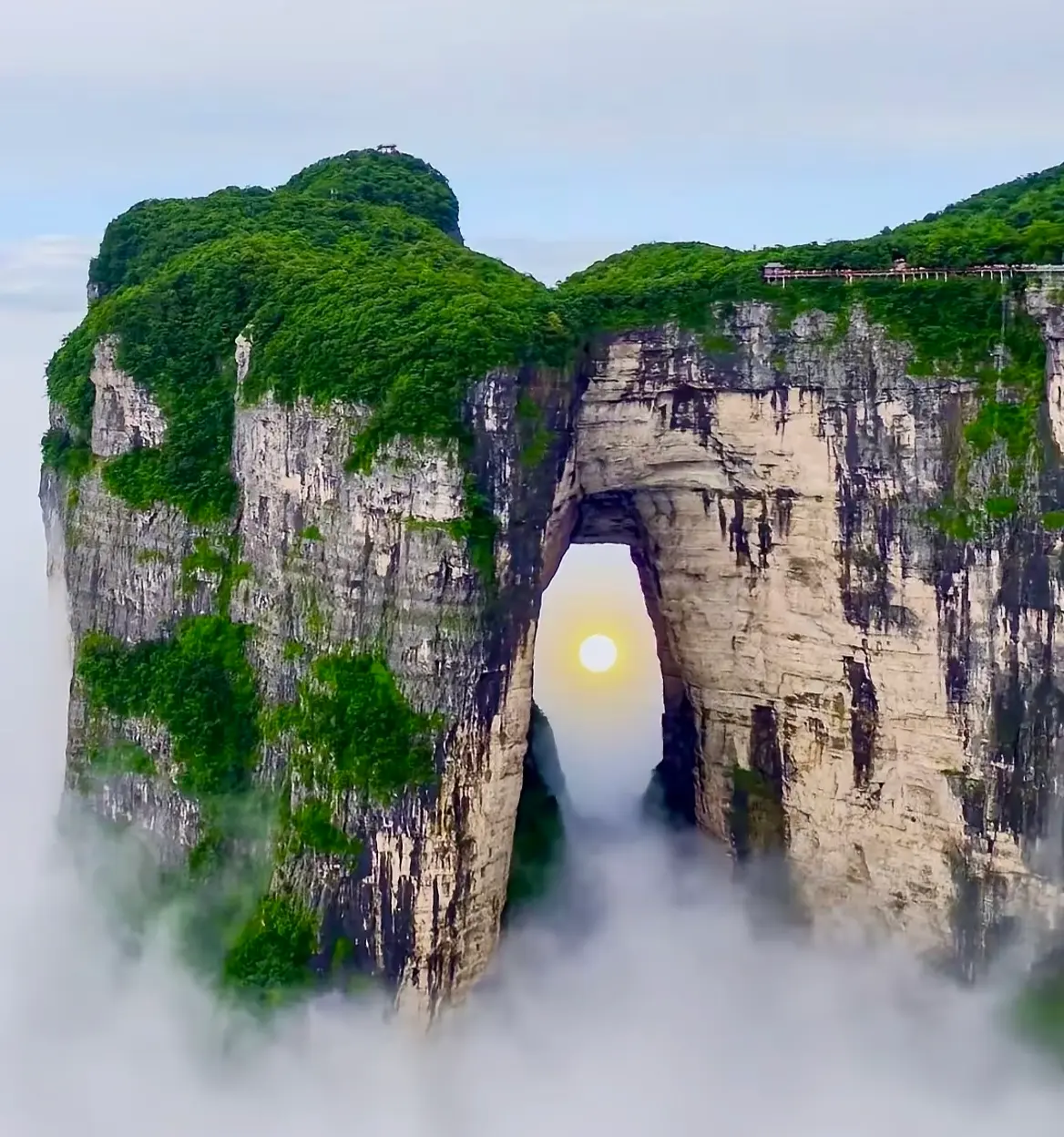
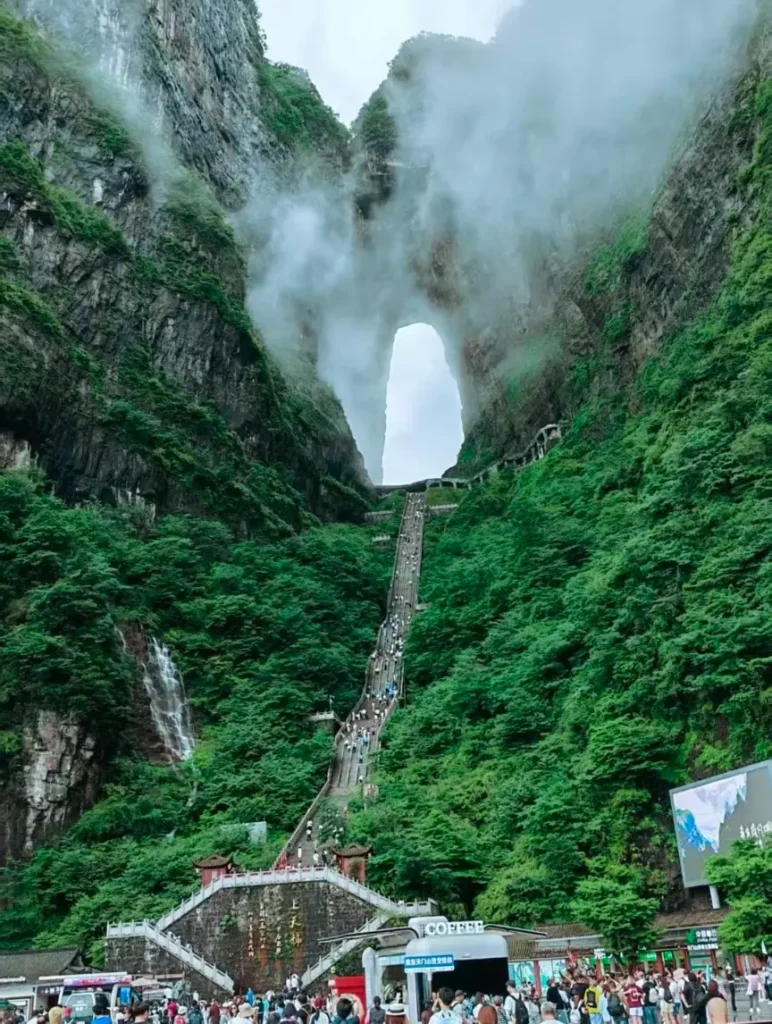
After finishing the summit trails, a rapid descent via the through-mountain escalators brings you to the defining spectacle of Tianmen Mountain—Tianmen Cave. Perched on a sheer cliff over 1,260 meters high, the cave is 131.5 meters high, 57 meters wide, and over 60 meters deep, making it the highest natural water-eroded cave arch in the world. Looking up from beneath the arch, the colossal opening frames the open sky. When mist and moisture roll through after rain, clouds surge back and forth right through the arch—a phenomenon known as “Tianmen Exhaling Mist,” creating the uncanny illusion of a real doorway leading up to heaven.
In front of the cave sit the 999 Steps to Heaven (Up Tianmen Stairs), spanning roughly 218 meters with a vertical drop of 120 meters and an incline approaching 45 degrees. Steep and imposing, these steps carry cultural blessings symbolizing supreme fortune and eternal longevity, serving as a pilgrimage route for blessings. Climbing them requires genuine physical effort; visitors with knee sensitivities or those wishing to skip the climb can opt for the paid through-mountain escalators directly down to the cave base. As for the cave itself—it doesn’t need to be “played with.” Standing right before it in quiet awe to absorb its monumental scale is the correct way to experience Tianmen Cave.
5. Tongtian Avenue: Navigating Tianmen Mountain’s 99-Bend Highway
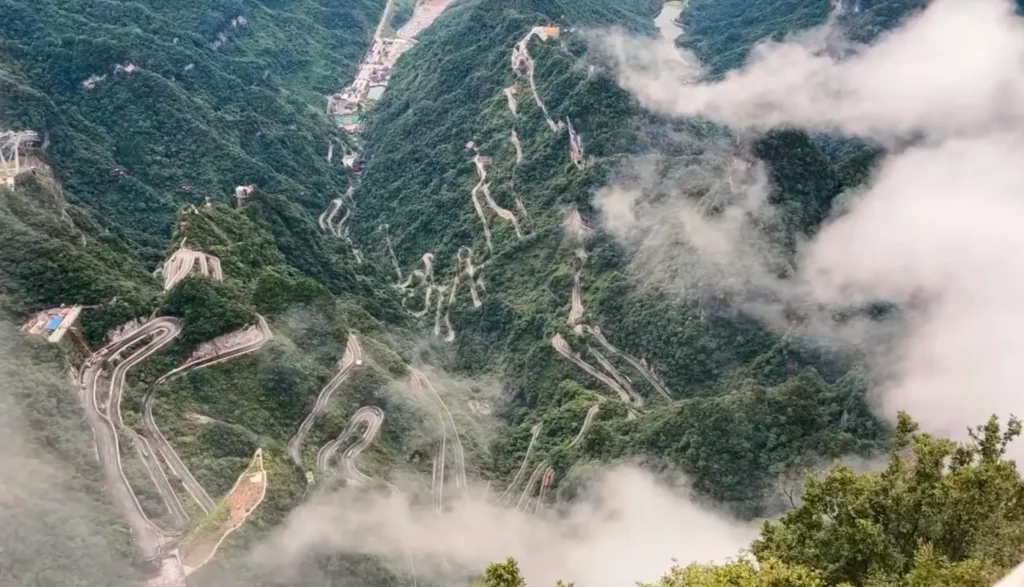
After taking in Tianmen Cave, your final stop is the legendary mountain-climbing highway sprawling beneath your feet—Tongtian Avenue. Spanning about 10.77 kilometers, the road weaves through 99 tight hairpin turns, climbing from an altitude of around 200 meters up to 1,300 meters, with a total vertical drop exceeding 1,000 meters (approx. 1,100m). Switchback riding down in an eco-bus is one experience; looking down at it from the cable car is another. The entire roadway resembles a twisted ribbon pasted against the steep mountain slopes, with turns so dense they look almost unreal, earning it the renowned title of “The World’s No. 1 Highway Wonder.” The 99 bends subtly echo the traditional concept of “Nine Heavens in the Sky.” Even if you choose not to drive down this road, you are guaranteed breathtaking bird’s-eye views of it from the cableway—making it one of Tianmen Mountain’s most photogenic highlights.
Summary: How to Plan Your 1-Day Tianmen Mountain Itinerary
Go to Tianmen Cave to witness the giant arch, take the cableway for panoramic views of the hairpin turns, and walk the Glass Skywalk and Ghost Valley Plank Road for an adrenaline rush. Tianmen Mountain and the Forest Park offer completely contrasting mountain experiences: one showcases an “ocean of stone peaks,” while the other presents “a gateway piercing the sky and pathways hanging on cliffs.” If you only have one day, following the smooth sequence of Cableway → Summit Garden → Plank Roads → Tianmen Cave → Tongtian Avenue will capture the absolute essence of Tianmen Mountain.
If you’ve just finished reading this and want a big-picture overview of Zhangjiajie’s top spots and how they connect, head back to our Zhangjiajie Scenic Attractions & Landmarks Guide.
However, knowing what to see is only half the battle—figuring out how to choose between Line A and Line B, avoiding cableway queues, finding the escalators, deciding whether to climb the 999 steps, and structuring the summit loops are the practical details that make or break your Tianmen Mountain trip. To unlock our complete playbook for Tianmen Mountain (including route selections, time management, and tourist trap warnings), check out our Tianmen Mountain Full Itinerary Guide.