Zhujiajiao Water Town Day Trip: How to Get There & Best Walking Route from Shanghai
What should you do with a second day in Shanghai? You could revisit the city center or head to Shanghai Disneyland. A third option is to travel one hour west out of the city to Zhujiajiao Water Town. While it cannot replace The Bund, it offers the half-day atmosphere that the downtown skyline never could: a winding canal, nine historic streets, thirty-six stone bridges, and a dramatically slower pace of life.
Quick heads-up: If this is your first time in Shanghai and you only have one day, dedicate that day to the city center instead.
📍 Related Guide: Shanghai One-Day Itinerary – Classic Attractions
1.Is Zhujiajiao Water Town Worth Visiting? Who Should Go (and Who Should Skip)
Let’s be clear about what to expect: this is not a day for ticking off major monuments—it is a day for changing your pace. Covering 3.08 square kilometers, the ancient town requires no general admission fee. Thirty-six stone bridges and nine centuries-old streets unfold along the canal, lined with more than a thousand Ming and Qing dynasty buildings.
It may not be the largest or most famous water town in China, but it has two unbeatable advantages:
- It is a living, breathing neighborhood. Many shops on North Street (Beidajie) are run by locals, residents still wash clothes by the river, and neighbors sit chatting at the foot of the bridges. Tourists and locals share the exact same streets, so what you see is real life rather than a movie set.
- It is the closest water town to downtown Shanghai. You can get here directly by subway without arranging intercity trains or separate overnight stays.
Go If You:
- Have already seen The Bund, Yuyuan Garden, and Lujiazui, and want to experience a completely different side of Shanghai.
- Want a relaxing day with zero queues, no stairs to climb, and plenty of spots to sit down after a short stroll.
- Are traveling with seniors or young children—the town is flat, making it easy to take breaks anytime.
- Love photography: whitewashed walls, quiet canals, and arched stone bridges create classic Jiangnan scenes.
Skip If You:
- Are visiting Shanghai for the first time with only one day (stick to the two downtown routes instead).
- Have just visited Wuzhen, Zhouzhuang, or Xitang, as the experience will feel repetitive.
- Are visiting on a weekend or national public holiday—the narrow main streets turn into a solid wall of people, and crossing bridges requires squeezing past crowds.
- Have a flight or high-speed train to catch the same day—the two-hour round-trip commute is a fixed time cost.

2. How to Get to Zhujiajiao from Shanghai (Metro, Bus & Last Train Times)
| Transport Option | Travel Time from Downtown | Cost | Best For |
| Metro Line 17 | ~1 hr 10 mins | 6 RMB | Most reliable option; unaffected by road traffic. |
| Huzhu Express Bus (Board at Pu’an Rd, People’s Square) | ~50 mins + 10-min walk | 12 RMB | Travelers who want a guaranteed seat without subway transfers. |
| Taxi / DiDi | 60–70 mins | ~120 RMB | Groups of 3 or more, or travelers with luggage. |
The main route to Zhujiajiao is Metro Line 17, which starts directly at Hongqiao Railway Station. The journey is straightforward: take Metro Line 2 or Line 10 from downtown to Hongqiao Railway Station, follow the signs inside the station to transfer to Line 17, and ride all the way to Zhujiajiao Station. Counting transfers, wait times, and the final walk, the trip from People’s Square takes roughly 1 hour and 20 minutes.
From Zhujiajiao Metro Station to the Ancient Town Entrance
- By Bus: Take Bus 1510 for 1 stop to the Tourist Center (1 RMB, 5-minute ride). Buses run every 15–30 minutes, with the last bus departing at 21:00.
- On Foot: Exit from Exit 1, turn left onto Zhuxi Road (220 m), turn right onto Xiangningbang Road (920 m), and turn left onto Xinfeng Road (170 m). Total distance is about 1.3 km (15 minutes).
Two Last-Train Deadlines to Remember:
The final Line 17 train heading back toward Hongqiao departs Zhujiajiao Station at 22:33. Meanwhile, Bus 1510 stops running at 21:00—if you stay to see the evening lanterns, you will need to walk back to the station.

3. Zhujiajiao Water Town Walking Route: Step-by-Step Itinerary & Ticket Tips
Zhujiajiao Ticket Prices & Combo Pass Strategy
Entering the ancient town is completely free—you can wander the historic streets, stone bridges, and canals without spending a cent. Only a few interior sites require admission, and how much you spend depends on what you want to see:
- Old streets, stone bridges & canals only: 0 RMB (no ticket needed).
- One quick garden stop: 20 RMB for a single ticket to Kezhi Garden (the largest and best-known garden).
- Gardens + Museum + Post Office: 60 RMB combo ticket—cheaper than buying individual entries, which total 80 RMB (Kezhi Garden 20 RMB + Hexin Garden 30 RMB + Helong Art Museum 20 RMB + Great Qing Post Office 10 RMB).
Tickets are available at the Tourist Center, attraction entrances, the official website, or Trip.com; foreign passports are accepted directly.
Step-by-Step Canal Walking Route
Rather than locking you into strict clock times, this guide follows a logical geographic sequence—start at whichever stop fits your arrival time:
| Order | Stop | Duration | How to Navigate & Why | Tickets & Tips |
| Stop 1 | Kezhi Garden | 1 hr | Enter the town from the Tourist Center and head straight to Kezhi Garden at the northern tip. Built in 1912 by Ma Wenqing, this manor garden reflects the motto “Never forget farming while pursuing scholarship,” featuring a library pavilion and a miniature rice-paddy courtyard. Quietest in the early morning. | 20 RMB (included in combo ticket). Open 8:30–17:00. |
| Stop 2 | Hexin Garden | 30 mins | Just a few steps south of Kezhi Garden. Assembled over ten years by Chinese-American collector Zhao Guoliang, its centerpiece is the Qing Dynasty Hexin Pavilion, relocated intact from the Three Gorges region. | 30 RMB (included in combo ticket). |
| Stop 3 | Boat Ride: Kezhi Pier → City God Temple Pier | 20 mins | Connects the central waterway so you don’t have to backtrack, passing through the town’s most picturesque “floating market” section. Buy tickets only at official piers—ignore touts on the street. | Priced by route length; up to 6 passengers per boat, starting at 200 RMB per boat (check posted pier rates). |
| Stop 4 | Caohe Street → North Street | ~1.5 hrs | Disembark right onto Caohe Street, home to two temples—one Taoist, one Buddhist—just minutes apart. First is the City God Temple (No. 69 Caohe St), featuring an antique opera stage, a giant suspended abacus, and a century-old ginkgo tree. A few minutes west is Yuanjin Buddhist Temple (built in the Yuan Dynasty; open 8:30–16:30). Spend ~20 mins at each, then grab lunch. Main street restaurants are pricey and crowded—step into side alleys for much better prices. | Check City God Temple ticket price on-site. Lunch averages 50–70 RMB per person. |
| Stop 5 | Great Qing Post Office | 30 mins | Cross the covered bridge midway down North Street to reach Xihu Street (No. 35). This is the only surviving Qing Dynasty post office site in East China—you can mail a postcard stamped with a Zhujiajiao postmark to yourself. | 10 RMB (included in combo ticket). |
| Stop 6 | North Street → Helong Art Museum | 1 hr | Cross back over the covered bridge to North Street and follow the canal toward Fangsheng Bridge. North Street is the town’s main commercial alley—only 2–3 meters wide at its narrowest, leaving just a sliver of sky overhead. At the far end sits Helong Art Museum, housing original works by masters Zhang Daqian and Cheng Shifa. | North Street is free. Museum: 20 RMB (included in combo ticket). |
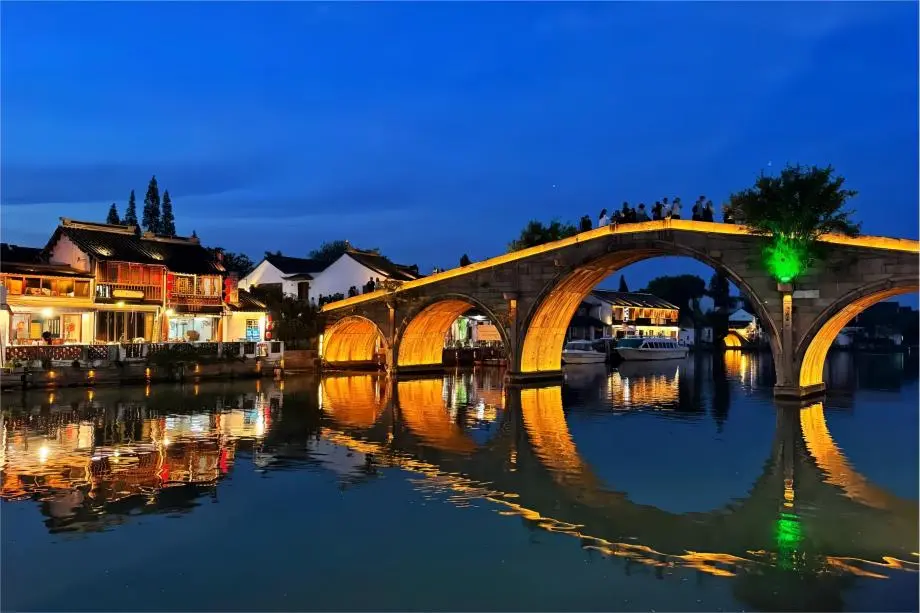
| Stop 7 | Fangsheng Bridge | 1 hr | Step out of North Street directly onto Fangsheng Bridge. Built in 1571 during the Ming Dynasty, this five-arch stone bridge is the highest point in town and offers sweeping panoramic views of the Caogang River. If the bridge is crowded, wait a few minutes for a lull before heading up. | Free. |
| Stop 8 (After 19:00) | Canal-Side Lanterns & Night Views | — | Town lights turn on nightly from 19:00 to 22:00, with the area around Fangsheng Bridge looking best. Don’t stand around waiting—step off the bridge into a canal-side teahouse or cafe until dusk. If you prefer not to wait, exit now. When ready to leave, exit via Xinfeng Road and follow Xiangningbang Road back to the metro (1.3 km, 15–20 mins). | Free. |

Adjustments for Rainy Days, Seniors, or Strollers
- If it rains: Skip Hexin Garden—Kezhi Garden has covered corridors where you can stay dry. Opt for a longer boat ride, as covered wooden boats keep you sheltered from the rain.
- With strollers or seniors: The town paths are flat, but every arched stone bridge has steps. Strollers will get stuck at bridges, so carrying toddlers or folding lightweight strollers makes moving around much faster.
4. what to Eat in Zhujiajiao: Must-Try Street Snacks & Local Restaurants
Street snacks in Zhujiajiao are far more memorable than sit-down banquets. Most stalls are clustered along North Street and Caohe Street, making grazing as you walk the best way to eat.
| Dish / Snack | Where to Find & Price |
| Granny’s Zongzi (Sticky Rice Dumplings) | Several heritage stalls on North Street; salted egg yolk & pork zongzi cost ~10 RMB each. Freshly wrapped and boiled so the sticky rice absorbs the savory meat juices—skip vacuum-sealed packs. |
| Braised Tied Pork (Zharou) | ~5 RMB per piece. Pork belly tied in bamboo leaves and slow-braised until rich and tender without feeling greasy; a signature local specialty. |
| Smoked Green Soybeans | ~15 RMB per bag. Savory, smoky, and pleasantly chewy—ideal for snacking on the train back. |
| Begonia Cake & Radish Fritters | 8 RMB and 3–5 RMB each. Freshly griddled and fried on the spot—eat them piping hot. |
| Sit-Down Jiangnan Dishes | Try steamed whitefish, stir-fried river snails in bean sauce, crispy river shrimp, and clam & tofu soup. Reliable spots include Caoxi Renjia, Jiaoli Jiujia, and Yihengguan (50–70 RMB per person). |
| A Bowl of Noodles | Eel noodles at Defa Noodle Shop or steamed shaomai dumplings at Rongxingyuan (30–35 RMB for a filling meal). |

What to Bring Back: Pickled vegetables and fermented bean curd from Handalong Sauce Shop (a staple among locals). For smoked green beans or gorgon fruit cakes (Qianshigao), buy them loose by weight rather than in tourist gift boxes—it is much fresher and noticeably cheaper.
5. Best Time to Visit Zhujiajiao Water Town (Crowds, Seasons & Night Lights)
- Best Timing: Weekdays, entering the town before 9:00 or after 16:00. Before 9:00, there are virtually no tour groups—only locals washing clothes by the canal and sweeping doorsteps. After 16:00, the low afternoon sun casts a warm golden glow across the whitewashed walls.
- Times to Avoid: Weekends between 11:00 and 15:00, as well as any Chinese national holiday. Because the main alleys are naturally narrow, heavy crowds turn walking into slow single-file shuffling.
- Best Seasons: March–May and September–November offer the mildest weather. Summer can be hot, though a sunset boat ride is one of the best experiences in town; winter sees the fewest visitors and atmospheric morning mist over the canals.
- Watch the Last Train: If you stay for the evening lights (19:00), keep an eye on the clock—the last Line 17 train to Hongqiao leaves at 22:33. Finish dinner before 21:00 so you have a comfortable 20 minutes to walk back to the station.
6. A Half-Day at Dianshan Lake: Eight kilometers west of Zhujiajiao, Shanghai’s largest freshwater lake
Zhujiajiao isn’t massive, and many visitors find they’ve seen the main highlights by early afternoon, leaving a few hours to spare. Here is our recommendation: once you’ve finished wandering the town, head eight kilometers west to Dianshan Lake. Spend the harshest afternoon hours by the shore, and head back just as the sun starts to dip—Zhujiajiao turns on its evening lanterns at 7:00 PM, making the lakeside sunset a seamless prelude to the town’s night river views.
Dianshan Lake is Shanghai’s largest natural freshwater lake, covering 62 square kilometers—roughly nine times the size of Hangzhou’s West Lake. More importantly, this is where the Huangpu River begins; the wide river you admire back at the Bund traces its very source right here.
There are no gates and no admission fees, and the activities here are delightfully simple. A cycling path runs along the lake, and the Rainbow Bridge on its eastern stretch offers the best panoramic views. The shores open up into broad lawns where locals bring their kids for weekend picnics. As the sun sinks toward the water in the evening, you get the quietest twenty minutes of the day. Unlike Zhujiajiao—which is all about narrow alleys, stone bridges, and old houses—here you get only water and sky, completing the other half of the Jiangnan experience.

On the western shore sits a small temple called Baoguo Temple. Originally a Ming-dynasty Guan Yu temple and now managed by the Jade Buddha Temple, it is free to enter and open from 8:00 AM to 4:30 PM. It lacks the usual tourist commotion: the courtyards are quiet, mostly filled with local elders burning incense or chatting under the verandas. Inside stands a very old ginkgo tree; in autumn, when the leaves turn gold, the afternoon light filters right through them onto the stone ground—often the most memorable snapshot of the entire trip.
Step out through the temple’s back door, and you are right on the lakeside boardwalk. Spend a quiet moment inside the temple first, then head out the back to the boardwalk to catch the sunset.
Getting There: A taxi ride from Zhujiajiao takes just over ten minutes (about 8 kilometers), or you can rent a bike and ride along the lake. If you prefer coming straight from downtown Shanghai, take Metro Line 17 to Oriental Land Station and walk to the lakeshore. Dining options right by the lake are quite sparse, so it’s best to head back to Zhujiajiao for dinner after sunset. For travel between Zhujiajiao and the lake, a taxi is by far the most convenient option, as local buses take much longer routes.