Yu Garden Shanghai: Garden, Yuyuan Bazaar & City God Temple Guide
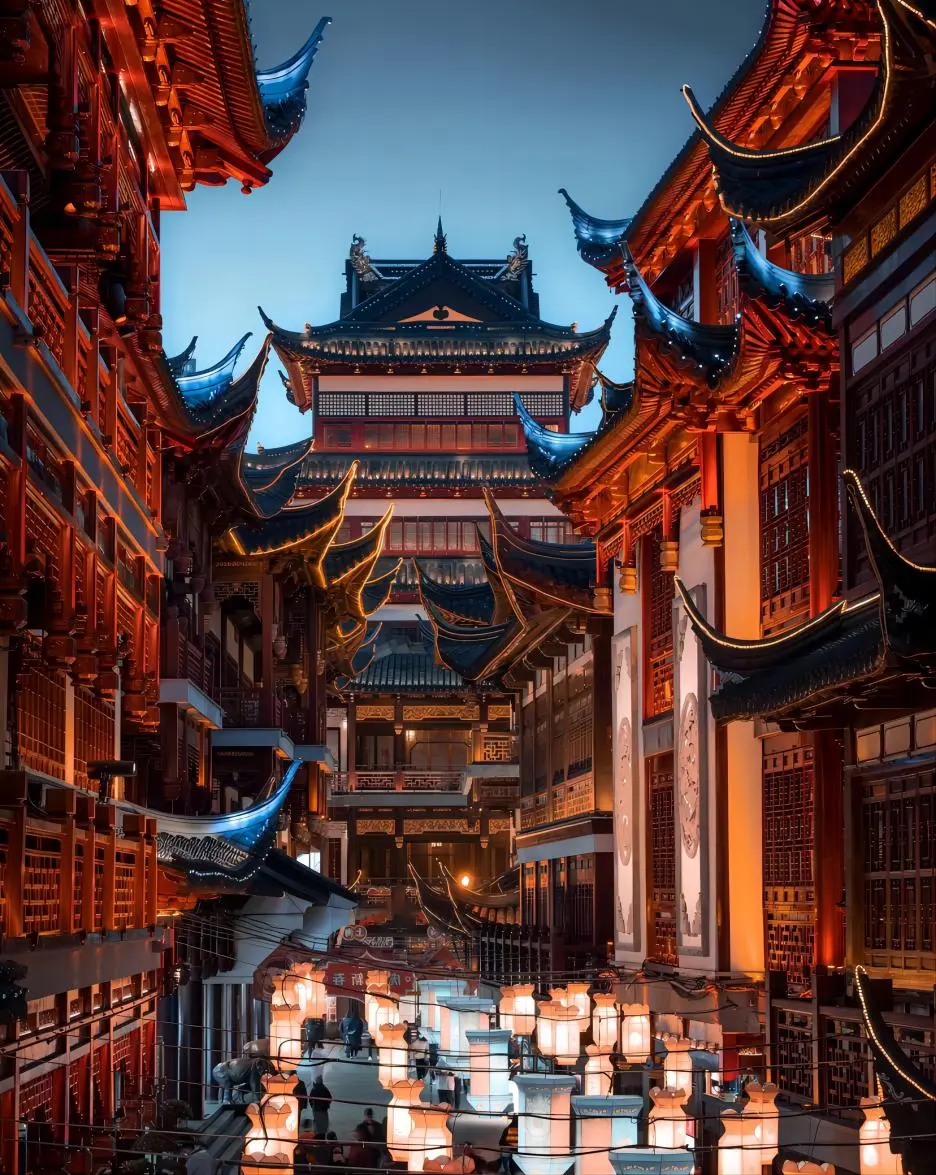
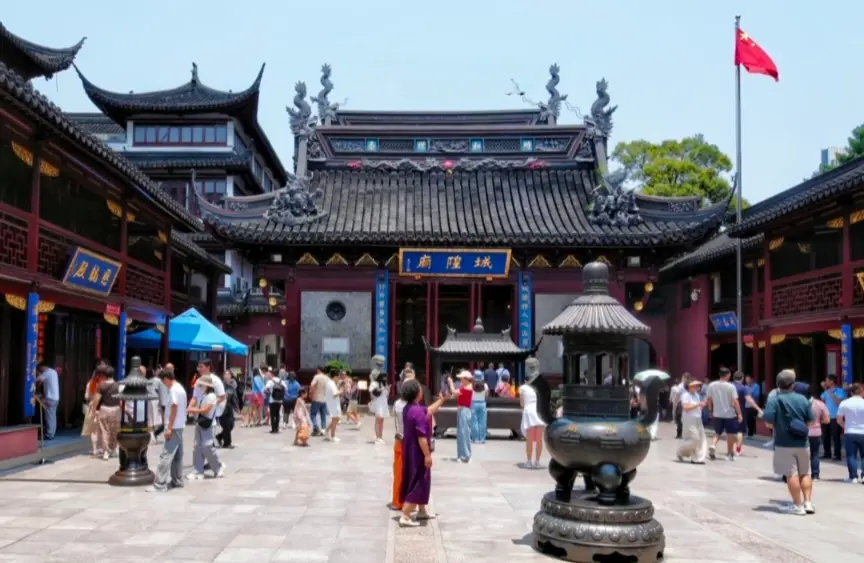
When people talk about “visiting Yu Garden(also known as Yuyuan Garden),” they are actually referring to three completely different places: a 400-year-old classical garden, a free historic shopping bazaar, and an active Taoist temple. They sit right next to each other on the map, yet each operates on its own ticket system and schedule.
This Yu Garden Shanghai guide separates all three upfront so you don’t buy the wrong ticket at the gate, then walks you through whether the classical garden is worth the entry fee, the best north-to-south walking route, and how to explore the surrounding bazaar and temple afterward.
1. Yu Garden Shanghai Explained: Garden vs. Bazaar vs. City God Temple
| Name | What It Is | Tickets & Hours | In One Line |
| Yu Garden (Classical Garden) 豫园 | A 400-year-old private Ming Dynasty garden and national heritage site | Peak season: 40 RMB; Off-peak: 30 RMB; Students & Seniors (60+): 20 RMB; Children under 1.3m or age 6: Free Hours: 9:00 AM – 4:30 PM (last entry 4:00 PM); Closed Mondays | The ticketed garden requiring about 1 hour |
| Yuyuan Bazaar / Old Street 豫园商城 | Traditional-style shopping district home to the Zigzag Bridge, Huxinting Teahouse, and heritage snack shops | Free admission, open all day | The spot for street food, photos, and souvenirs |
| City God Temple 上海城隍庙 | An active Taoist temple dedicated to Shanghai’s guardian deities | 10 RMB (includes 3 incense sticks) Hours: 8:30 AM – 4:30 PM (opens at 6:00 AM on the 1st & 15th days of the lunar month) | The working temple for burning incense and blessings |
| Yu Garden Lantern Festival 豫园灯会 (Spring Festival) | Annual Lunar New Year lantern display lasting ~36 days (only the folk-art lantern zone requires a ticket) | Adults: 80 RMB; Children, Seniors & Military: 50 RMB (2026 rates) Entry: From 4:00 PM on regular days, 2:00 PM on peak days; closed on Lunar New Year’s Eve | The seasonal night event requiring a separate ticket |
The #1 Point of Confusion: Saying “Yu Garden is free” is true if you mean the surrounding bazaar; saying “Yu Garden requires a ticket” is true if you mean the classical garden. Because English travel guides often call both “Yu Garden,” sorting out this distinction first saves plenty of confusion at the entrance.
How to Buy Tickets: For international visitors, the smoothest booking options are Trip.com, Klook, and GetYourGuide. All three offer English interfaces, accept international credit cards, and send a QR code you can scan directly at the gate. Keep in mind that Yu Garden uses real-name, timed-entry reservations that sell out once daily capacity is reached. During spring, autumn, and public holidays, book at least one day ahead—and bring the physical passport registered at checkout if you buy student, senior, or free child tickets.
2. Is Yu Garden Worth Visiting? Ticket Prices & What to See Inside
Yes—as long as you understand what a Chinese classical garden actually is. It is not an open lawn park.
In traditional Chinese design, a classical garden is an enclosed family compound combining living quarters, reception halls, and study pavilions inside a walled private world. Wealthy owners brought miniature mountains, ponds, rockeries, trees, and pavilions into their own backyards so daily life unfolded inside a three-dimensional landscape painting. Yu Garden is the finest surviving example of this tradition in Shanghai.
Founded in 1559, the garden was built over nearly two decades by government official Pan Yunduan on land behind his family home so his aging parents could enjoy a peaceful retreat—the character Yu (豫) literally means “to please and bring comfort to one’s parents.”
Four Architectural Highlights Inside Yu Garden
- Hand-Stacked Rock Mountains: The Great Rockery was built entirely by hand without machinery, relying on master craftsmen to stack boulders into peaks and caves that double as scenic viewpoints.
- Pavilions Built Over Water: Halls like Yangshan Hall and Cuixiu/Juanyulou rest half on land and half on stilts over the pond, so sitting along the corridor feels like floating in the middle of the water.
- Lattice Windows as Picture Frames: Ornate cutout windows (lou-chuang) punctuate the whitewashed walls; every few steps shifts the view framed inside, embodying the garden principle of “a new scene with every step.”
- Poetic Names on Every Corner: Names like Sansui Hall, Dianchun Hall, and Exquisite Jade Rock are paired with classical inscriptions and backstories that act as the original owner’s interpretive plaques.
Covering just over two hectares (roughly three soccer fields), the garden takes 40 minutes at a brisk pace or 90 minutes at a leisurely stroll. Its biggest strength is density: from the grand reception halls at the entrance to the Great Rockery, Exquisite Jade Rock, Dianchun Hall, and the Inner Garden, highlights appear back-to-back with almost no empty filler.
When to Skip the Ticket: If you only want traditional tiled roofs, soup dumplings, and evening lanterns, the free Yuyuan Bazaar outside delivers all of that—save your 40 RMB. Note that there are no food stalls inside the classical garden, and eating while walking is not permitted.
3. Best Yu Garden Walking Route: North Gate to South Gate
How to Get to the Yu Garden North Gate
Yu Garden has separate north and south gates. Enter through the North Gate (168 Fuyou Road) so your exit naturally drops you right beside the Zigzag Bridge. Taking the metro is the easiest way:
- Metro Line 10 (Yuyuan Garden Station, Exit 1): Walk east along Fuyou Road for about 600 meters; the entrance is on your right.
- Metro Line 14 (Yuyuan Garden Station, Exit 7): Walk east along Renmin Road for 200 meters, turn right onto Anren Street, and walk south for 170 meters.
If taking a taxi or Didi, set your drop-off to 168 Fuyou Road (福佑路168号). Old Town streets are narrow and prone to holiday gridlock, so the metro is often faster during peak hours. If you are coming from The Bund, it is a straightforward 20-minute walk south through older neighborhood streets.
Inside Yu Garden: 7 Stops from North to South
The path flows cleanly from north to south with zero backtracking, taking about 60 minutes (or 90 minutes if you linger):

- Sansui Hall (Three Tassels Hall): The grand main hall just inside the entrance—look up at the timber roof beams and read the stone stele recounting the garden’s origins.
- Yangshan Hall & Juanyu Tower: Positioned directly across a pond from the Great Rockery, offering the most balanced panoramic angle in the garden.
- The Great Rockery (Da Jiashan): Built from yellow stone by renowned Ming rockery master Zhang Nanyang, this is one of the oldest surviving rockeries in the Jiangnan region.
- Wanhua Chamber (Chamber of Ten Thousand Flowers): Located in the middle section, typically less crowded than the opening courtyards.
- Dianchun Hall (Heralding Spring Hall): Served as the command headquarters of the Small Swords Society uprising in 1853, giving the hall a noticeably bolder, more historic atmosphere.
- Exquisite Jade Rock (Yu Linglong): Yu Garden’s prized centerpiece—a porous Taihu limestone boulder standing in front of Yuhua Hall.
- The Inner Garden (Nei Yuan): The final, compact section at the southern end. Most visitors are tired by this point, making it the quietest corner to catch your breath.
The South Gate exits at 279 Yuyuan Old Street, stepping straight out onto the Zigzag Bridge and Huxinting Teahouse.
Best Time to Visit Yu Garden & Opening Hours
- 9:00 AM – 9:30 AM (Opening Half-Hour): The garden is nearly empty and angled morning sunlight makes for clean photos, though many bazaar shops outside are still opening their shutters.
- After 3:00 PM (Before the 4:00 PM Last Entry): You will share the paths with afternoon crowds, but exiting around dusk times your walk perfectly with the bazaar lanterns lighting up around the Zigzag Bridge.
- Avoid Mondays: The classical garden is closed on Mondays (except national holidays). The surrounding bazaar stays open, meaning you will only see half the experience. During Lunar New Year, hours follow the annual Lantern Festival schedule.
4. Exploring Yuyuan Bazaar: Zigzag Bridge, Teahouse & Street Food
Exiting the South Gate (279 Yuyuan Old Street) puts you directly inside Yuyuan Bazaar. Originally the temple fair surrounding the City God Temple, it is now an open-air complex of traditional-style lanes—free to enter and open all day with no gates.
Must-See Spots in Yuyuan Bazaar
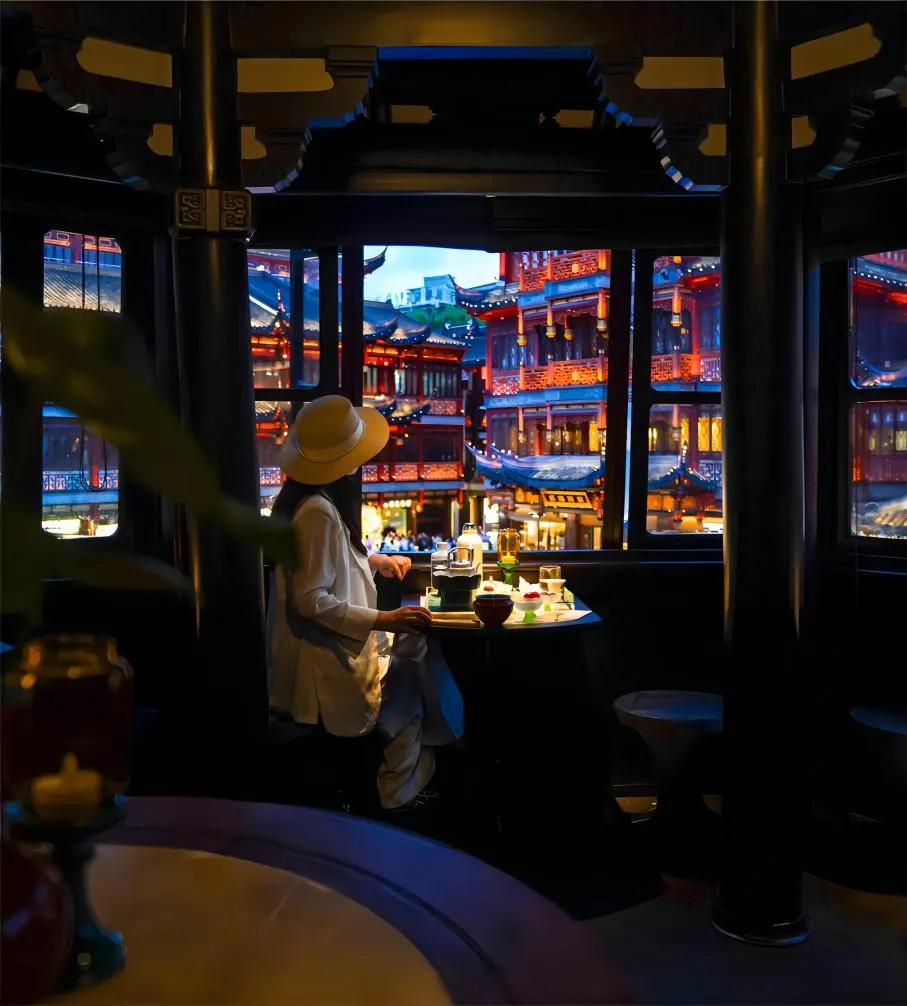
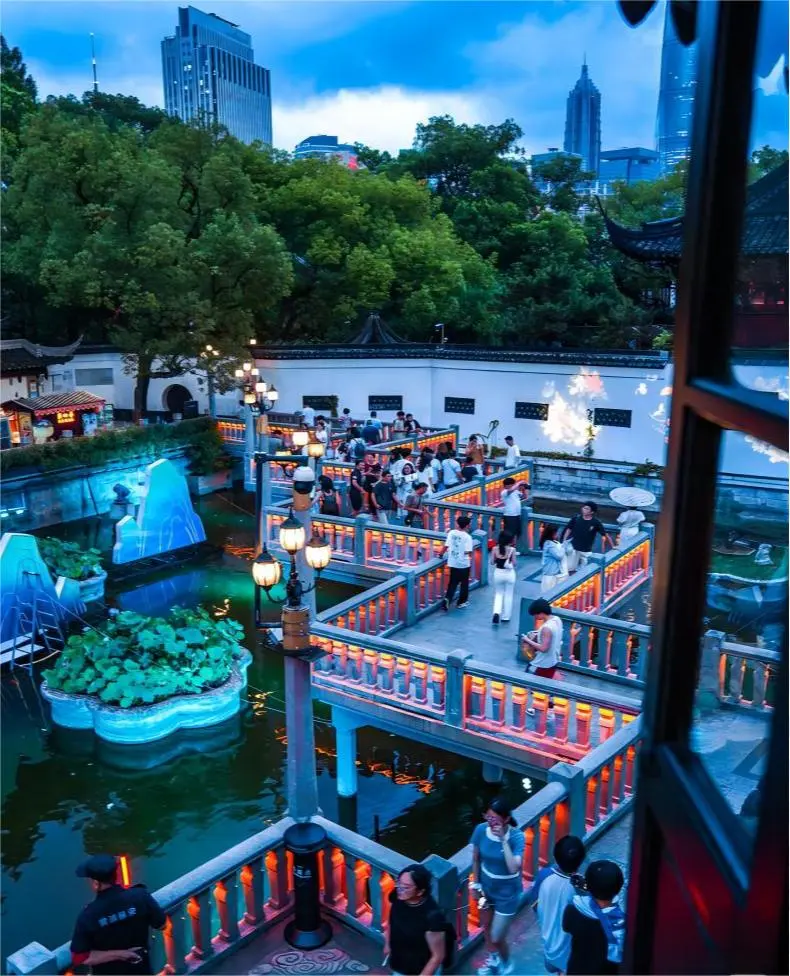
- The Zigzag Bridge & Huxinting Teahouse: Just steps from the South Gate, the Nine-Turn Bridge bends sharply across the pond—traditionally said to ward off bad luck, and practically designed to slow crowds down to enjoy the view. At the center of the bridge sits Huxinting Teahouse, where an upstairs window seat overlooks the constant flow of visitors below.
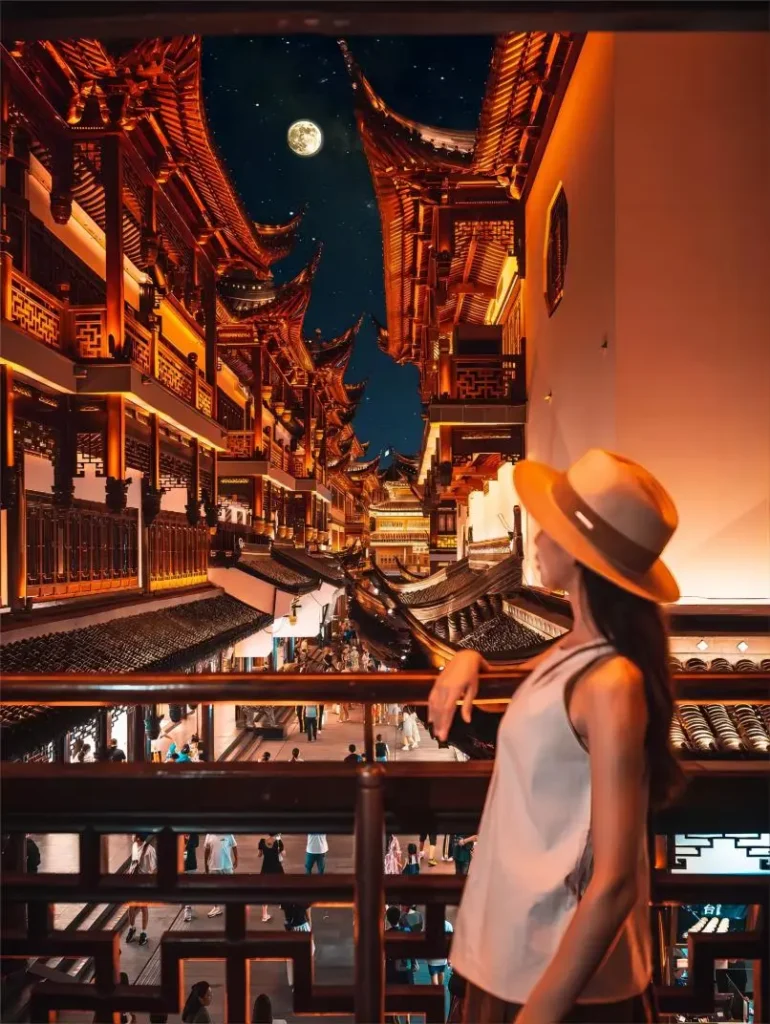
- Old Street Lanes: Centered around Middle Fangbang Road and Yuyuan Old Street, these alleys are packed with pastry shops, tea merchants, and souvenir stalls. Busy by day, the district looks most atmospheric after dark when the eaves light up—though evening crowds are also at their peak.
Where to Eat Near Yu Garden
- Nanxiang Steamed Bun Restaurant: Right beside the Zigzag Bridge; famous for crab-roe soup dumplings (xiaolongbao)—and equally famous for its long lines. Skip the midday lunch rush if you can.
- Lubolang: A heritage Shanghainese restaurant serving classic local dishes and dim sum; pricier than street stalls, with prime views for a proper sit-down meal.
- Budget Alternative: Step a block or two north onto Fuyou Road, where similar local snacks and dumplings cost noticeably less.
Where to Go After Yuyuan Bazaar
The bazaar area is compact—walking from the Zigzag Bridge to Middle Fangbang Road takes 10 minutes. From here, The Bund is a 20-minute walk north, and the main entrance to the City God Temple is just 5 minutes away inside the same district.
5. Shanghai City God Temple: Tickets, Hours & Temple Etiquette
Located inside the bazaar block at 249 Middle Fangbang Road (a 5-minute walk from the Zigzag Bridge), the City God Temple is not a museum shell—it is a living Taoist temple where Shanghai locals regularly come to burn incense and pray to the city’s traditional guardian deities.
- Admission & Hours: Entry costs 10 RMB (which includes three incense sticks). Open daily from 8:30 AM to 4:30 PM, opening early at 6:00 AM on the 1st and 15th days of the lunar month, when local worshippers fill the courtyards.
Four Etiquette Rules for Visiting the City God Temple
- Step over the wooden threshold: Never step directly on the raised wooden doorsill when entering a hall.
- Fan out incense flames by hand: Never blow out burning incense sticks with your mouth.
- Respect the statues: Avoid pointing fingers at deities or posing with your back turned to altars for selfies.
- Yield to worshippers: If someone is bowing or offering incense, walk around behind them rather than cutting directly in front.
Allow 20 minutes if you just want to admire the architecture and lively atmosphere, or 30 minutes if you plan to light incense. Unlike the classical garden next door, the City God Temple stays open on Mondays.
Once you know how the ticketed classical garden, the free Yuyuan Bazaar, and the active City God Temple fit together, Yu Garden Shanghai becomes one of the easiest and richest half-day stops in Old Shanghai.
Continue Planning Your Shanghai Route:
- Coming from or heading to the waterfront? Read our The Bund Shanghai: Best Time, Light Show Hours & Walking Route.
- Fitting Old Shanghai into a broader trip? Follow our Shanghai 3-Day Itinerary: 2 Fixed City Days & 1 Choice for Day 3.
6. Frequently Asked Questions About Yu Garden Shanghai
Are Yu Garden and the City God Temple the same place?
No. Yu Garden is a ticketed Ming Dynasty classical garden, while the City God Temple is an active Taoist temple. Both sit side-by-side inside the free Yuyuan Bazaar district.
Do you need a ticket for Yu Garden?
Yes for the classical garden (40 RMB peak season / 30 RMB off-peak), and 10 RMB for the City God Temple. Walking through the surrounding Yuyuan Bazaar and across the Zigzag Bridge is completely free.
Can I visit Yu Garden on a Monday?
The ticketed classical garden is closed on Mondays (except public holidays), but Yuyuan Bazaar and the City God Temple remain open as usual.
How much time do I need for Yu Garden?
Plan 1 to 1.5 hours inside the classical garden, plus another 1 to 1.5 hours for Yuyuan Bazaar, snacks, and the City God Temple—2.5 to 3 hours total works comfortably.
When is the Yu Garden Lantern Festival?
The festival runs for roughly 36 days around Lunar New Year, lighting up about 20 days before New Year’s Day and continuing through the Lantern Festival (which falls on February 20, 2027). Exact dates are announced each December, so check official listings before traveling. Ticket prices are set per edition—for reference, 2026 rates were 80 RMB for adults and 50 RMB for children and seniors.